




This is a preview of what proved an incredible finale – click here for the full report and results.
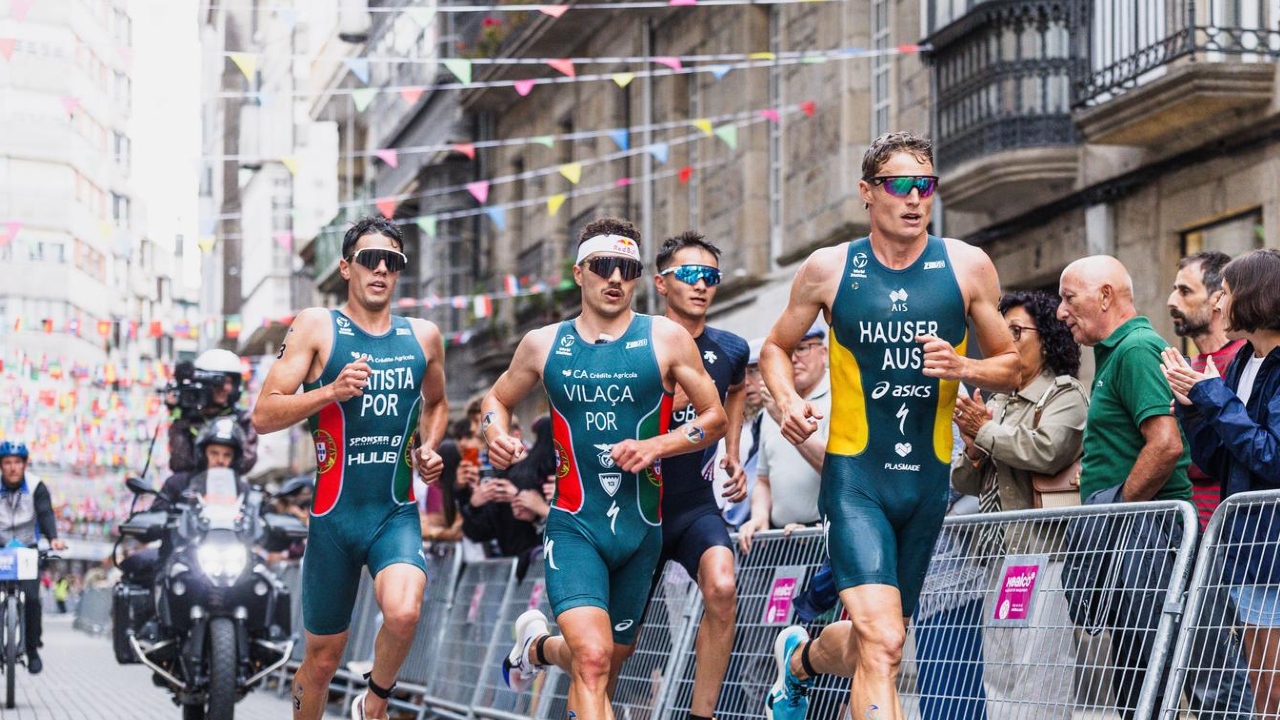
The men’s world title will be decided at the WTCS Grand Final in Pontevedra on Sunday, with Vasco Vilaça attempting to convert a commanding points advantage into the biggest success of his career.
The Portuguese star leads defending champion Matt Hauser by 354.24 points following a season in which the pair have established themselves as the dominant forces in the series.
Vilaça has claimed two WTCS victories in 2026, while Hauser has won three times – but the Australian has finished ahead on both occasions that the title rivals have raced one another.
A top-five finish will guarantee Vilaça the world crown, regardless of Hauser’s result.
But Hauser knows exactly how to deliver at a Grand Final, having dominated in Wollongong last year to claim his first senior world title.
Here’s everything you need to know…
Start time and how to watch live
The elite men’s race at the 2026 World Triathlon Championship Finals takes place on Sunday 27 September.
The race starts at 18:00 local time, which is 17:00 in the UK, 18:00 CEST, 12:00 Eastern Time and 09:00 Pacific Time.
As ever, the action will be shown live on the official World Triathlon streaming platform, TriathlonLive.io.
How the WTCS standings work
An athlete’s final WTCS score is made up of their best four results from the regular season plus their result at the Grand Final.
A normal WTCS victory is worth 1,000 points, while 1,250 are available to the winner in Pontevedra.
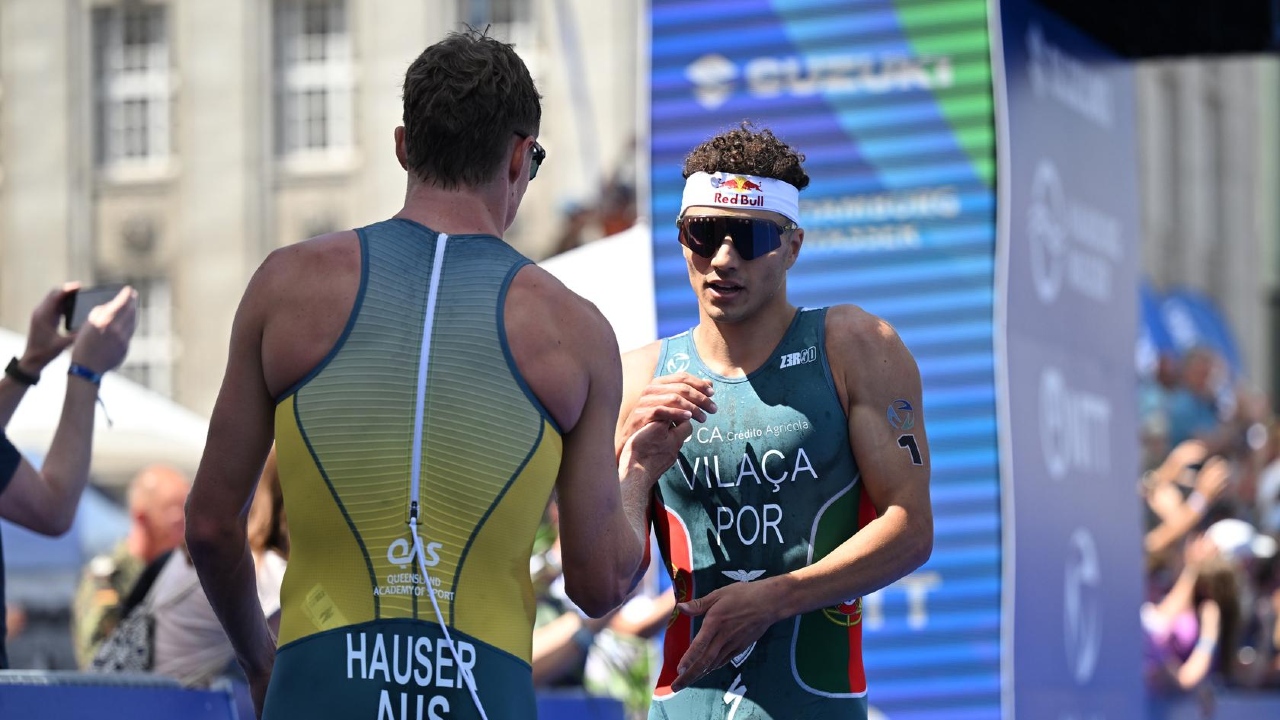
Vilaça leads the standings with 3,850 points, giving him a significant advantage over Hauser on 3,495.76.
Ricardo Batista is third on 3,082.13, followed by Miguel Hidalgo on 3,040.67 and Dorian Coninx on 3,018.80.
| Position | Athlete | Nationality | Points |
|---|---|---|---|
| 1 | Vasco Vilaça | POR | 3850.00 |
| 2 | Matthew Hauser | AUS | 3495.76 |
| 3 | Ricardo Batista | POR | 3082.13 |
| 4 | Miguel Hidalgo | BRA | 3040.67 |
| 5 | Dorian Coninx | FRA | 3018.80 |
| 6 | Csongor Lehmann | HUN | 2495.46 |
| 7 | Luke Willian | AUS | 2480.61 |
| 8 | Tom Richard | FRA | 2429.56 |
| 9 | Tjebbe Kaindl | AUT | 2420.92 |
| 10 | Henry Graf | GER | 2407.03 |
What does Vilaça need to win the world title?
The simplest equation belongs to Vilaça: finish fifth or higher and he will be world champion, no matter where Hauser places.
Even victory for the Australian would not be enough to overhaul Vilaça if the Portuguese athlete finishes inside the top five.
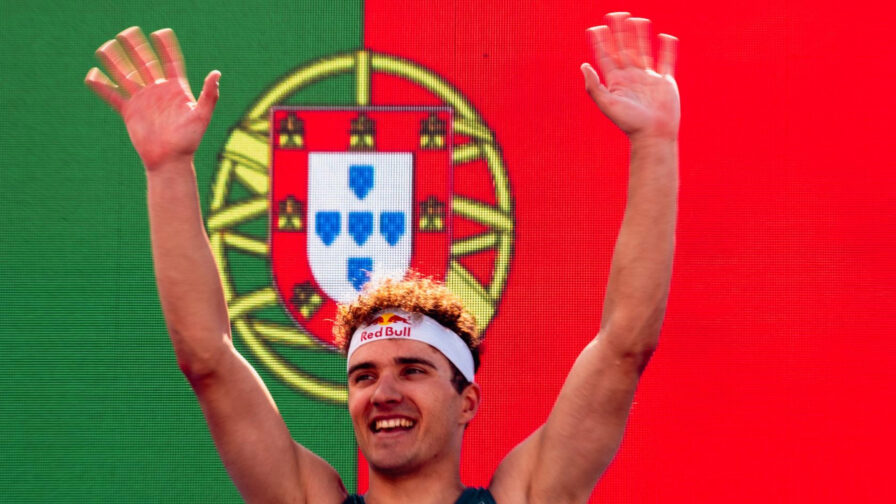
But while his advantage is substantial, Vilaça’s previous results at the Grand Final will offer Hauser hope.
He finished 23rd in 2022 and entered the 2023 Final in Pontevedra with a chance of becoming world champion, only to slip to 15th as Coninx produced a remarkable title-winning performance.
Vilaça was then 24th in 2024 and fifth in Wollongong last year – the latter one of only two occasions all season on which he missed the podium.
As well as overcoming that Grand Final record, Vilaça could do with finding a way to beat an opponent who has repeatedly had the upper hand in their head-to-head meetings.
The pair have raced together twice in the 2026 Series and Hauser finished ahead on both occasions.
How can Hauser retain his title?
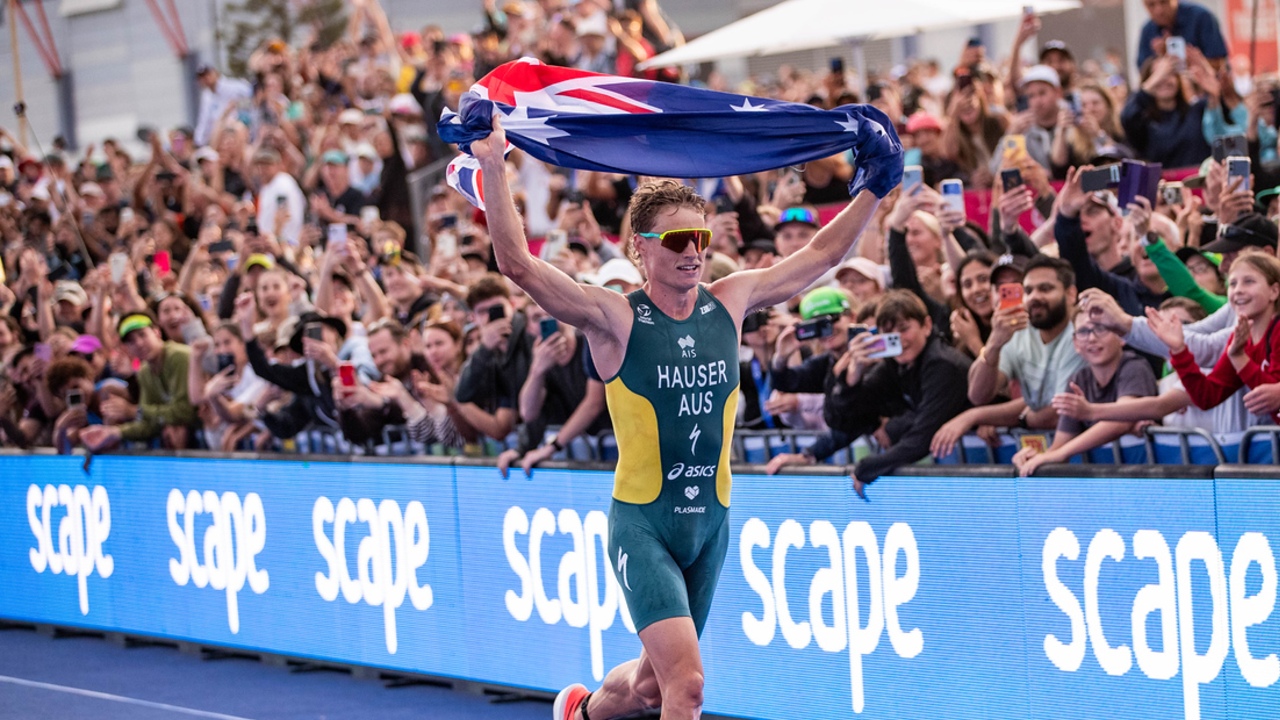
Hauser’s clearest route to a second successive world title is to win in Pontevedra and hope Vilaça finishes sixth or lower.
There are other possible combinations. Second place could be enough if Vilaça drops to seventh or worse, while a third-place finish would require the leader to be ninth or lower.
But victory remains the result most likely to put maximum pressure on Vilaça.
Hauser arrives after his worst finish of the season in his final regular-season appearance, but there are clear parallels with 2025.
He also entered last year’s Grand Final following his poorest WTCS result of that campaign before delivering a commanding victory in Wollongong.
That experience could prove crucial if the title race becomes as much a psychological test as a physical one.
Vilaça has the points advantage, but Hauser has three victories this year, an unbeaten 2026 head-to-head record against the Portuguese star and the confidence that comes with being the defending world champion.
Can anyone else win the world title?
Batista, Hidalgo and Coninx remain mathematically in contention, although all three require an extraordinary combination of results.
Batista’s clearest route would be to win the race, with Vilaça 14th or lower and Hauser seventh or worse.
Hidalgo would need victory, Vilaça to finish outside the top 14 and Hauser to place seventh or lower.
Coninx starts fifth in the standings, 831.20 points behind Vilaça. His most straightforward route would require another Pontevedra victory, with Vilaça 16th or lower and Hauser eighth or worse.
Those scenarios appear unlikely – but Coninx has already produced one of the greatest Grand Final comebacks.
He arrived in Pontevedra fifth in the standings in 2023 and 511 points behind leader Alex Yee, yet won the race and emerged as world champion.
The Frenchman has also won twice during the 2026 season, making him considerably more than a mathematical footnote.
Wilde and Yee could transform the race
The world-title calculations may revolve around Vilaça and Hauser, but two of the biggest names in short-course triathlon could decide which of them succeeds.
Hayden Wilde arrives in outstanding form after winning the IRONMAN 70.3 World Championship in Nice and then following it with victory at the French Riviera T100 six days later.
The New Zealander cannot challenge for the overall WTCS title, but his presence has the potential to change the entire race.
Wilde won the 2024 Grand Final by more than a minute and is one of only two men to have defeated both Hauser and Vilaça in the same WTCS race since the beginning of last season.
He also has unfinished business in Pontevedra. Wilde entered the 2023 Final with a major opportunity to win the world title but endured a difficult race which included a costly penalty for dropping his swim cap before the first transition.
Alex Yee has similarly painful memories of that afternoon.
The Briton led the standings before the race but fell from first to fifth as Coninx claimed the title.
Yee responded by winning Olympic and world gold in 2024, but victory at a WTCS Grand Final is still missing from his remarkable record.
His running speed makes him an obvious threat if he remains in contention through the bike – and every position taken by Yee or Wilde could prove decisive in the championship battle.

Who else could contend?
Hidalgo is the other man in the field to have beaten both Hauser and Vilaça in the same WTCS race since the start of 2025.
Batista has emerged as a consistent podium contender and gives Portugal another significant presence alongside series leader Vilaça.
Home favourite David Cantero del Campo returns after finishing second at last year’s Grand Final, while Italy’s Alessio Crociani was third in Wollongong.
Csongor Lehmann has already reached a WTCS podium this season, and Canada brings a particularly strong group featuring Weihai medallist Tyler Mislawchuk, Charles Paquet, Martin Sobey and Mathis Beaulieu.
Tim Hellwig was second when Pontevedra last hosted the Final in 2023 and produced his best WTCS result since then with fifth in Karlovy Vary.
Oliver Conway and Henry Graf are notable absentees after both were ruled out through injury.
Course and distance
The elite men will race over the standard Olympic distance – a 1,500m swim, 40km bike and 10km run.
The swim consists of two laps in the Lérez River before the athletes enter the first transition on its northern bank.
The bike features nine laps through Pontevedra, with each main circuit measuring 4.17km.
World Triathlon’s detailed profile shows 54.8m of elevation gain per lap, giving approximately 493m of climbing across the nine circuits.
Although the course reaches a maximum elevation of only 20m, its steepest uphill gradient is 11.1%, while the descent reaches 15%. Repeating that pattern nine times should create opportunities for aggressive riders to apply pressure and make the race increasingly selective – something we’ve seen time and again in men’s races in the WTCS in 2026, though Alex Yee did nearly make up a 2:12 deficit on the run last time.
The concluding 10km run comprises three laps of 3.37km, each circuit containing 46.8m of elevation gain, producing a total of around 140m across the run.
Both the bike and run pass through central Pontevedra, including the area around Praza da Ferraría, before finishing at the CGTD, a small municipal sports stadium.