



Victor Jarland was only 200m into his debut triathlon when a gut-wrenching wave of anxiety, panic and reality hit him – he was nowhere near as prepared for this new test of endurance as he had hoped.
A keen cyclist and more than capable runner, the Swede had joined thousands of fellow age-groupers in signing up for the ultimate multisport challenge. Little did he know that those opening minutes in the water would change the course of his life.
Charlotte Pegg, his girlfriend at the time and now his wife and business partner, had also signed up for the Triathlon du Mont Blanc and, having finished her sprint race that morning, was eager to cheer Victor on as she watched the Olympic-distance swimmers exit the water and head into transition.
‘I literally thought he had drowned’
“I remember thinking, gosh, Victor’s taking ages. And he’s very competitive. I thought something must have happened because everyone was coming out of the swim, and I couldn’t see him,” recalls Charlotte. “I literally thought he had drowned or something because he was pretty much at the back, which is unlike Victor.”
Never having experienced a mass start in open water, Vic received a rude welcome that day to a discipline of triathlon that he hadn’t really paid much attention to before. Indeed, it was almost enough for him to question whether this was the sport for him after all.
“After three years of cycling, I think I had got a bit bored, and Charlotte was a keen runner, so we started running together… it wasn’t long before we started to think that ‘Hey, this isn’t too far from a triathlon, is it?’,” says Victor.
“I thought that my fitness would carry me through the swim, but I admit that I was very humbled that day. Just 200m into my first triathlon swim, I suffered a massive panic attack and really wondered if I belonged in this sport.
Desire to improve his swimming technique
“I was bumped a few times, got a foot in my face, and had someone grab hold of my foot and drag themselves over me. I might have even had a wetsuit on that was too small for me, which obviously didn’t help with the breathing.”
The fact that he did eventually make it across Lac de Passy and then go on to ‘ride the best bike of my life’ and record his best-ever 10km run time meant that by the time he had crossed the line, he was ‘hooked on triathlon… absolutely addicted’.
All he had to do was put in some extra swim training, and who knows? Maybe he could also learn to love that aspect of the race as much as he did cycling and running?
Ten years on from what he still describes as a ‘horrible moment’, it is that desire to improve his swimming technique that sees Vic and Charlotte close to launching their latest, state-of-the-art dryland swim-specific training tool.
The launch of ZEN8 is a success
Frustrated with their slow progress, various attempts to increase pool time were hampered by their busy work lives, and it became far too easy for them to scrap their planned swim workout for a run or a bike ride.
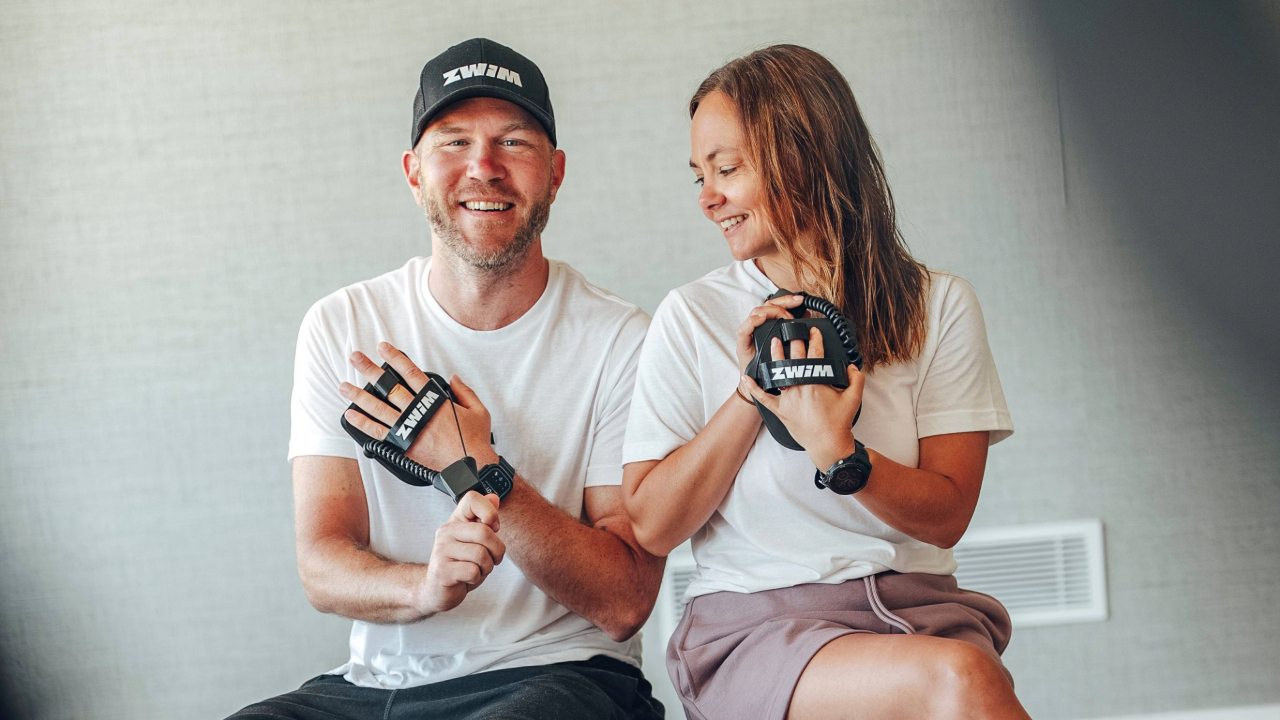
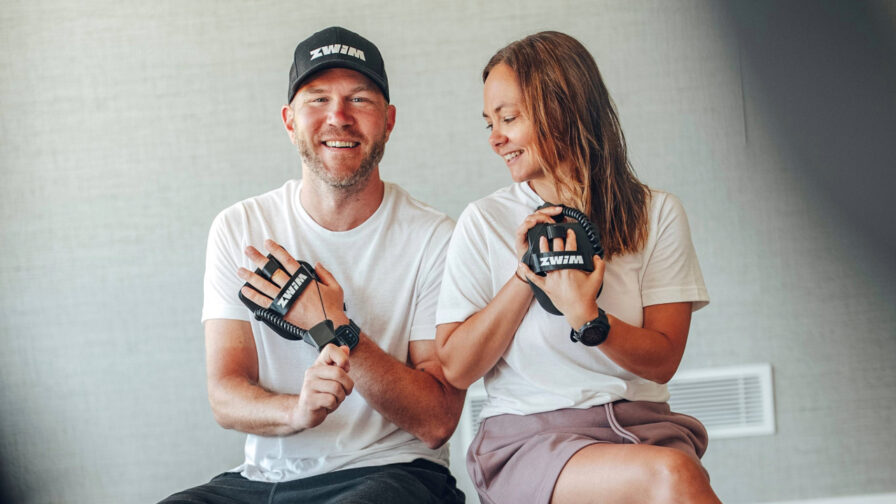
ZWIM is the result of many years of hard work, from a couple who were not content with simply ‘surviving the swim’ on race day and wanted a solution which allowed age-groupers like themselves to work on technique and power from the comfort of their own homes.
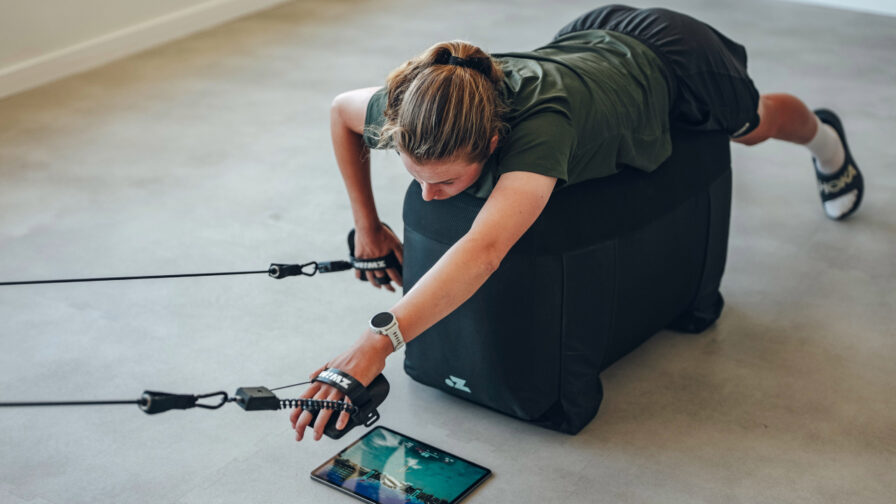
Their first project saw the release of ZEN8 – a home trainer using a swim bench, pulley system and resistance bands – utilised by more than 20,000 people and which, when used consistently, left athletes feeling stronger, faster and more confident.
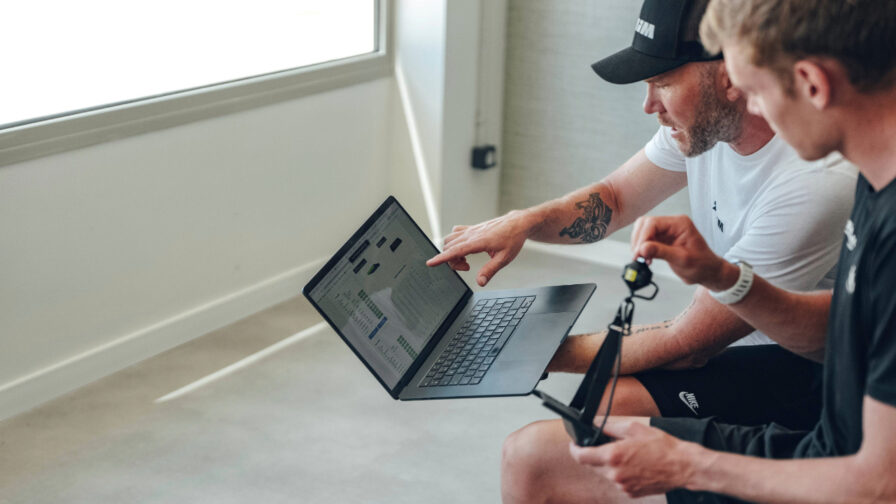
ZWIM Smart Trainer takes that model and soups it up with the latest in gaming technology, adding more data than ever before through the new ZWIM Smart Paddles, which can record propulsive watts, efficiency, stroke rate, distance and left/right balance, while also linking efforts to a real-time in-game experience which is designed to keep the hunger for improvement burning.
Importance of propulsive watts
By tracking propulsive watts, ZWIM shows athletes how effectively they can combine force with technique. Press hard with a sloppy catch, and it won’t reward you. A beautiful catch with no force won’t either.
ZWIM lets the athlete know where they are going wrong… and most importantly, how to fix it.
Bespoke training plans, training insights and workout statistics will also be available once ZWIM launches, delivering a real game-changer when it comes to at-home, dryland, Connected Swim Training.
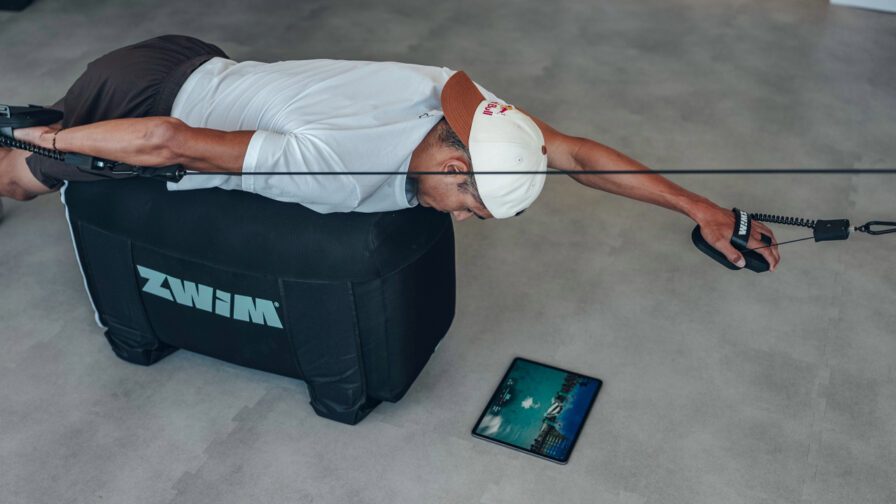
Designed to accompany and work alongside regular pool work, ZWIM Smart Trainer is for those days in between – the ones that were never going to be pool days anyway – when you can pull on the smart paddles and spend a little extra time working on that all-important technique.
The jump from ZEN8 to ZWIM is significant, and the journey Victor and Charlotte took in getting to where they are today was very much a leap of faith, requiring some pretty drastic decisions.
Proud enough to post times on Strava
Living in Val d’Isère, they were both made redundant from their hospitality roles when the COVID-19 pandemic hit, and the decision to try and take ZEN8 forward into its next phase would see them selling up, moving to Lisbon, and throwing everything they had into the project.
“There were a few lightbulb moments,” says Victor. “But I would say the first came during lockdown when I was at home training on all these prototypes that we had in the flat. I was basically just working on my technique, understanding my catch and my movement.
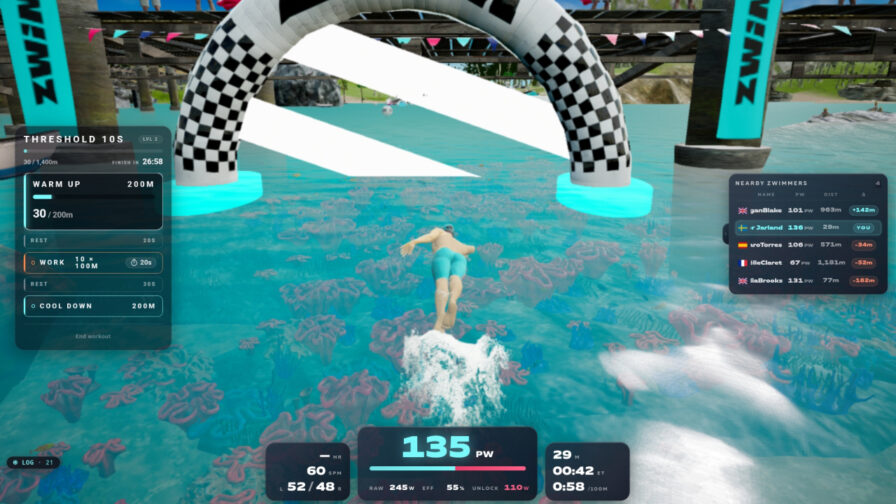
“Through the repetition, I was improving my stroke, and I started to build in some strength sessions. I was doing that two or three times per week, ten to 35 minutes at a time, while I was stuck at home. The pools were shut, so I had nowhere to swim.
“I used to be a 1:55/2:00 per hundred metre swimmer, and when I got back in the pool on my first day, I powered through 200 metres and 400 metres, and I was looking at my watch and couldn’t believe what I was seeing… it was like 1:45, 1:44.
“My first thought was that the watch was broken, but I kept on swimming, and the times held up. That was the first time that I remember feeling proud enough to actually upload my swim to Strava.
Triathlete Kieran Lindars signs up
“Two days later, I went back into the water keen to validate my times, and I was still there. It was incredible. That work I had done at home on the trainer had paid dividends big time, and it gave us so much confidence that we were onto something that could help age-groupers like ourselves.”
As the positive reviews continued to roll in from customers, partnerships were also formed with the BMC triathlon team – now the Bianchi Pro Triathlon Team – with former World Champion Chelsea Sodaro keen to make use of a home trainer having recently given birth.
Another professional who has been integral to the journey is British triathlete Kieran Lindars, who, having been sent an early version of the ZEN8, has now been helping the team to develop ZWIM.
“It’s really a tool to help you work on the propulsion phase of the stroke, working on the technique, your catch and your early vertical forearm,” adds Victor. “If you can only get to the pool twice a week, then if you can do the work on your stroke at home, it gives you more time in the pool to focus on other aspects such as breathing and kicking.
A tool to help between pool days
“We are super focused on solving problems for the age group athlete… basically, myself. It’s my own problem, right? Around 85-90% of all age-group triathletes are coming from a non-swimming background and always struggle with it. And the advice that they hear from better swimmers, or real swimmers, is to just ‘swim more’.
“It’s great advice, but it doesn’t work if you have family, work, two other sports, and life commitments to fit in… it’s just impossible. Then you start feeling lazy and maybe questioning if you’re motivated or disciplined enough because you can’t just go and swim.
“That’s why I think what we are building is such a good tool to help people between pool days and really as a supplement to their training. You can work at home on your technique with technology that tells you where you are going wrong.
“Technique is everything at a certain level. If athletes can become more efficient, they can see an impact on their times; they suddenly find themselves swimming better for longer. But swim-specific endurance, especially for someone getting into swimming late as I did, is as important. ZWIM can help people achieve both of those.”
For more information on the ZWIM Smart Trainer, visit the website HERE.