



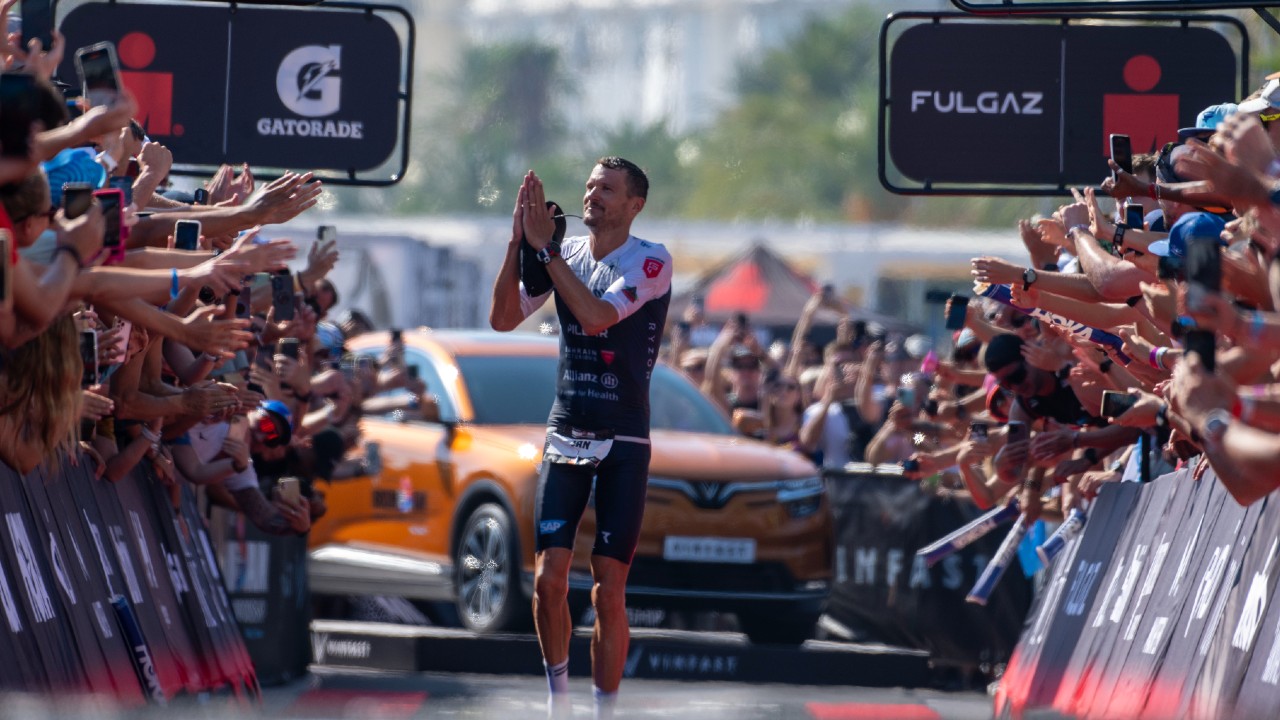
Jan Frodeno spent much of his extraordinary triathlon career making some of the hardest things in endurance sport look remarkably easy.
But as he prepares to take on one of trail running’s biggest stages at UTMB Mont-Blanc this week, the three-time IRONMAN World Champion isn’t exactly talking up his chances.
“I suck at uphill and I suck at downhill,” joked Frodeno ahead of Thursday’s OCC race. “So I’m really looking forward to the flat sections, which according to the map are not many!”
The 2008 Olympic champion is being deliberately self-deprecating, of course. Because while Frodeno is certainly no threat to the world’s best trail runners just yet, the evidence suggests he’s considerably better at his new sport than he’s letting on.
And three years after calling time on arguably the greatest career in triathlon history, the 45-year-old is relishing the opportunity to be a beginner again.
Frodeno takes on trail running’s biggest week
If Kona is triathlon’s most iconic gathering, then UTMB week in Chamonix is probably its closest equivalent in trail running.
Thousands of runners descend on the Mont-Blanc region for a week of racing, with the flagship UTMB 100M bringing together many of the world’s greatest ultra runners.
Frodeno will instead race OCC, which UTMB bills as “the ultimate challenge for mid-distance ultra-runners” and is the 50K category final of the UTMB World Series.
This year’s course measures 60km with around 3,500 metres of elevation gain, starting in Orsières in Switzerland before finishing in Chamonix.
Speaking to Dylan Bowman in an excellent interview on the Freetrail podcast – which you can watch in full below – Frodeno admitted that simply experiencing an event of this magnitude is part of the attraction.
“It’s just so cool to come out to such an iconic event,” he said.
“You hear so much about it. The restrictions of being a pro don’t always allow you to come and see other iconic events, whether it be swimming, cycling, running, or any other sport.
“And so I am very, very curious and just soaking it up like a kid.”
Don’t be fooled by Frodeno’s modesty
Frodeno insists his objective is considerably more modest than those he once carried into Kona.
When Bowman suggested OCC could effectively be described as a short-to-middle-distance trail running world championship, Frodeno replied: “There you go. For me, it’s the long, long distance!
“I just want to come from a place of not sucking for 60k.”
But there’s some important context here.
Frodeno had to qualify for OCC, and did so with an excellent performance at Nice Côte d’Azur by UTMB last September.
He finished 16th out of 1,731 finishers over 54.5km and was first in the M40-44 category.
Frodeno turned 45 on August 18 and has therefore moved into the M45-49 category for OCC. His UTMB 50K Index of 709 is impressive, with only five of the 83 male runners in that age group at OCC ranked higher.
The UTMB Index is designed to provide a common measure of performance across trail races and is calculated from a runner’s best results over the previous 36 months.
So while Frodeno may be approaching OCC with very different expectations to the races which defined his triathlon career, don’t be surprised if he proves competitive among his age-group peers.
That needs separating, though, from what is happening at the front of the race.
Swiss mountain-running superstar Rémi Bonnet has a UTMB Index of 956, while Italian Francesco Puppi is rated 953 – illustrating the enormous gulf between being an extremely good recreational trail runner and one of the best in the world.
Puppi also provides a neat link between Frodeno’s old and new worlds, having recently appeared as a guest on the German’s ‘Going Mental’ podcast.
Why trail running came next
Perhaps the most interesting part of Frodeno’s transition isn’t how fast he might run at OCC, but why trail running has become such a natural fit since his retirement from professional triathlon.
He lived for around a decade in Catalonia, one of trail running’s great hotbeds, before moving to Andorra four years ago.
“It just makes sense because, let’s be honest, the road running in Andorra sucks,” he explained. “It only is up or down, and it just makes absolute sense to try something completely different.”
There’s a physical reason too.
Frodeno estimates that during his career he spent 23 years running between 4,000 and 5,000 kilometres annually.
“My knees and Achilles and all these kind of things, they’re not really loving a huge amount of repetition.
“And it’s funny how I can now just head out in the mountains for a couple of hours and nothing hurts.
“I found that the difference in every single step kind of allows you to actually be kind of pain-free.
“You’re still out there pumping your body, but it just hurts in a different way.”
How seriously has Frodeno trained for OCC?
Given Frodeno’s reputation for meticulous preparation throughout his triathlon career, Bowman understandably questioned whether one of endurance sport’s great competitors could really turn up at OCC simply to enjoy himself.
Frodeno insists that’s exactly what he’s doing.
“I can genuinely say that I am coming from a place of just that, actually quite casually,” he said.
It has taken time for his body to recover from professional sport, with Frodeno estimating it needed around 18 months before many of the Achilles problems and other niggles which plagued the latter stages of his career finally settled down.
His trail-running journey hasn’t been entirely straightforward either.
After spending much of one winter teaching himself to ski, Frodeno entered a 25km UTMB race in Andorra and pulled his hamstring after around 20km – ironically on one of the few flat sections.
His preparation for OCC has included some longer runs and bike rides, but this isn’t Frodeno attempting to reproduce the all-consuming approach which helped make him an Olympic champion, three-time IRONMAN World Champion and two-time IRONMAN 70.3 World Champion.
And that’s rather the point.
‘I just want to be ready for whatever’
Frodeno spent his professional life specialising.
Every swim, bike and run session ultimately had a purpose, with years of preparation distilled into a handful of races where winning was everything.
Retirement has given him the opportunity to rediscover sport without that requirement.
“Someone put it well the other day when they said to me, it’s like I just want to be ready for whatever,” he explained.
“If you call me up at three tomorrow morning and we’re like, ‘Dude, let’s go ride our bikes around Mont Blanc,’ I’d be like, ‘Okay, sweet, let’s do it.’
“If you want to go paragliding, I’m like, ‘Yeah, I think I could do that.’ Whatever it is, that’s what I want to do.
“Rather than specialise and put all my beans in the same basket again and really go out and do the repetition and all those kind of things. That’s why I say I happily retired from that space and from that part of me as an athlete.”
That shift even extends to competition.
Frodeno says that when he plays tennis these days, he doesn’t particularly care whether he wins. What matters is hitting the ball well and enjoying a few good rallies.
“I know there is always somebody putting in more effort,” he added.
“I know what it takes to win.”
And despite everything Frodeno achieved in triathlon – and the fact his early trail-running results suggest he possesses more ability than he admits – he has no illusions about transforming himself into an elite trail runner.
“I don’t even think that genetically I would have the talent to be really competitive at trail running,” he said.
“If I look at the people running downhill, I don’t see the same trail!”
For once, winning doesn’t appear to be the point.
Frodeno is in Chamonix to discover something new – and, after more than two decades spent knowing exactly what was expected of him as one of the world’s best triathletes, that might be precisely the attraction.
And his immersion in the trail-running world is continuing away from the race itself. Frodeno’s ‘Going Mental’ podcast has now passed 20 episodes, with OCC contender Puppi among his recent guests, while this week in Chamonix he will sit down with arguably the biggest name of them all, Kilian Jornet.
After that, though, comes 60km and 3,500 metres of climbing at OCC.
There aren’t many flat sections.


![Jonas Schomburg wins in Kalmar 2026. [Photo credit: IRONMAN]](https://www.tri247.com/wp-content/uploads/2026/08/1H5A7725_Gfhj69jc_20260815012118.jpg)