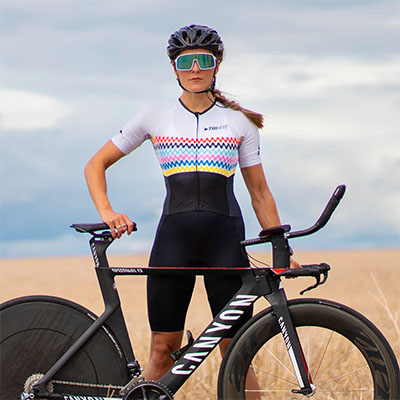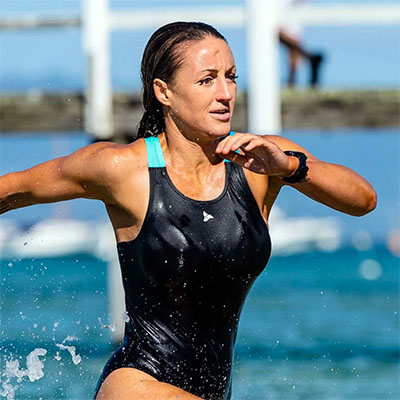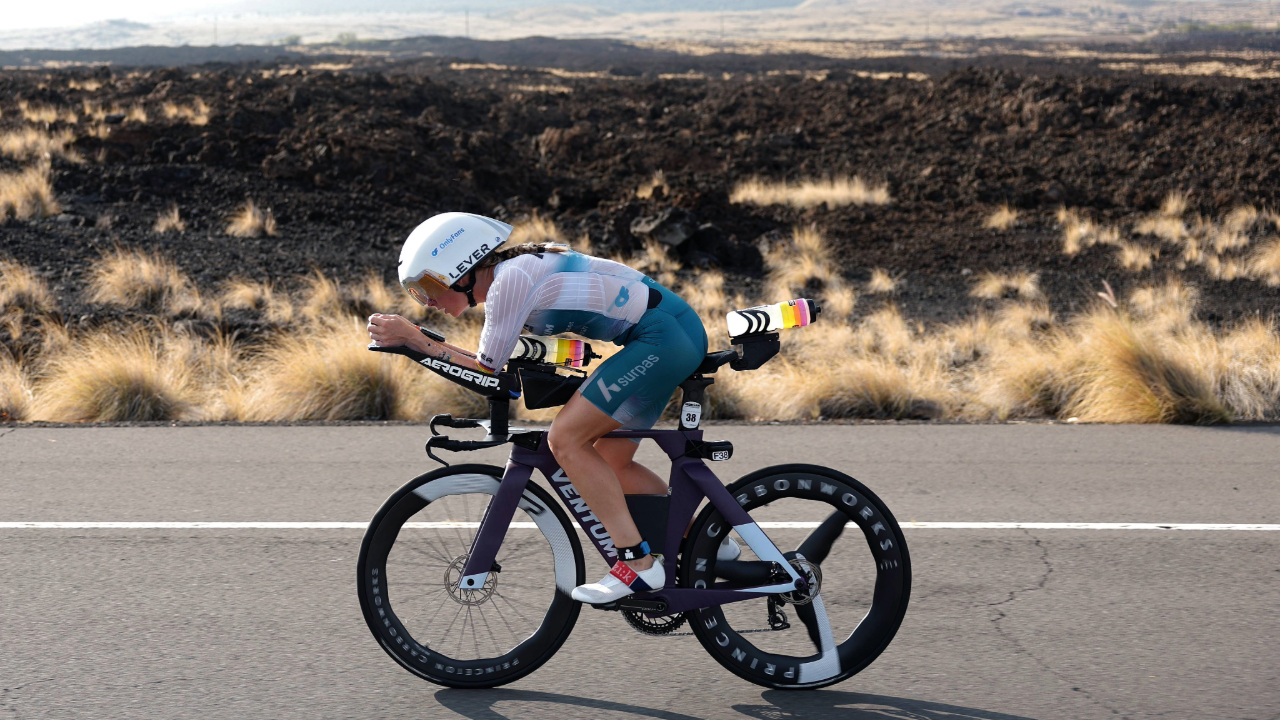





Steph Clutterbuck is to make a sooner-than-expected return to triathlon next month as she continues searching for answers to the ongoing POTS health issues, which have blighted the opening two races of her season.
The British competitor struggled with bouts of dizziness and hyperventilation at both IRONMAN New Zealand and the 70.3 in Geelong before announcing she was going to take some time out of competition to seek professional advice on how to deal with the condition.
Postural orthostatic tachycardia syndrome is a chronic autonomic nervous system disorder characterised by a rapid heart rate increase upon standing, causing dizziness, fainting, and fatigue. While no cure exists, management involves lifestyle changes and medications, often associated with increased fluid and salt intake.
Limited understanding and research
Speaking on their latest ‘Buck The Trend’ podcast, Clutterbuck and her partner, Matt Hnatiw, revealed how they have spent the past month researching a condition which clearly makes life difficult for professionals from any sporting discipline.
With limited understanding and knowledge of how an elite competitor can focus on training and racing while suffering from POTS, the duo have sought advice from a wide field of athletes in a bid to come up with both a new training regime and nutrition plan.
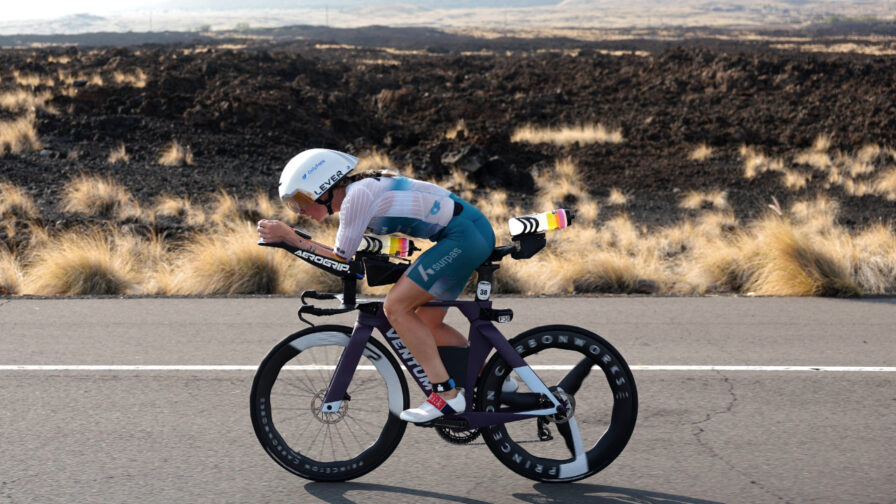
Clutterbuck is now ready to put the new training and nutrition regimen – which she has nicknamed the ‘Hnatiw Method’ – to the test by signing up to compete at IRONMAN Lanzarote on May 23.
One of their key findings has been that Steph’s symptoms seem to be triggered by the nerves and excitement of race day, meaning that while she can usually train without too much trouble, as soon as the adrenaline hits, she is once again struggling to sometimes even stand up.
Training and nutrition changes
Her training schedule has now been adapted to fit in with the condition, having found that easy workouts and extreme sessions are less likely to trigger the symptoms than mid-range efforts.
This polarised approach now means that 80-90% of her training will be easy, and the remaining 10-20% will be extremely difficult and will be coupled with a three-days-on, one-day-off and two-days-on, one-day-off schedule. At the moment, she is completing 25 hours of training a week but is hoping to increase that level over time.
Clutterbuck is already feeling the benefits but now needs that race in Lanzarote to validate her new approach – an approach which she also hopes will enable her to qualify for a slot at the world championships in Kona later this year.
“There’s no getting away from it that if you want to compete in the realms of long-distance triathlon, you probably need to be upwards of 20 hours a week,” she says on the video, which is embedded into the story above.
Steady progression is required
“You’ve got people who are doing way more. So, if you’re looking at a bell curve, then 20 is probably on the lower end, but it is a benchmark to aim for. And the last couple of months, I’ve barely been able to hit 15. So, I was not achieving what we needed to in the slightest and just getting less and less fit.
“So, we looked at this polarised approach and looked at weeks in the past where I have performed well, and if we can get to 20 to 25 hours of swim-bike-run-gym, then that would be a place that mentally would leave me confident. I can execute these because I’ve put together these really solid training weeks. If we can, one day, nudge it up higher, then great.”
By stacking weeks and weeks of the easier work on top of each other, she is hoping that the additional really hard work will then pay dividends, an approach which has been corroborated by other athletes out there who also suffer with POTS.
“This is a difficult area because there’s no research; there’s no science where someone has done a study on people with POTS, and they say ‘this approach works best’,” she says. “But everyone we’ve spoken to has said, ‘Easy is great; hard is great, but that middle zone of sustained effort always triggers symptoms’.
“So if the Norwegians get the ‘Norwegian Method’, we are calling this the ‘Hnatiw Method’ – where rest days are full rest days; you have two of them in a week, and you do a polarised training approach.”
Lanzarote will be the next big test
And with more than a month to go until the race at Lanzarote, they know there is plenty of time to fine-tune any further problems that might arise.
“I know I said that I wanted time to not race, slow down, and really kind of take the pressure off – and not doing Texas was absolutely the right idea – but I am on a start list,” she says. “I really want to give myself the opportunity to qualify for Kona. I fully believe that I can, as long as I manage to get the kind of run that I need.
“We don’t need to have all of the answers, but if I can just deliver a fine run, I’m confident that I’m able because of my swim and bike; I’ll be able to qualify for Kona. It’s difficult to go onto a start line, but every race we’re learning something new, and every race we’re putting something in place, whether it looks like it from the outside or not. So I’m on the start line for IRONMAN Lanzarote.”