



With World Triathlon announcing last week that the IOC had approved the qualification system for the 2028 Olympics in Los Angeles, now is the perfect time to start looking at how the leading nations are shaping up heading towards the start of the two-year process.
The window opens on 18 May 2026 and concludes on 18 May 2028 – and there are more details here on how the final 55 women and 55 men will be determined.
The obvious nation to start our series, which will run between now and May, is the United States – not just because they are the hosts but in recent Games they have had some of the trickiest selection calls given the strength in depth on the female side.
Taylor Spivey was a controversial omission ahead of Tokyo while last time out for Paris it again went down to the wire.
In a nutshell
The host country is guaranteed spots for one Mixed Relay team (two women and two men), provided they have eligible athletes.
A maximum of three athletes per country can qualify if all are ranked in the top 30 and that will be the clear aim for the Stars & Stripes over the next cycle.
And while the Olympic qualification points don’t start stacking up until mid-May, that doesn’t mean the WTCS and World Cup events before then are meaningless as they will boost an athlete’s World Triathlon Ranking, which determines their eligibility to enter races.
How the last Olympic cycle played out for the USA
Taylor Knibb, Taylor Spivey, Kirsten Kasper, Morgan Pearson and Seth Rider were the athletes who represented the USA at Paris 2024 – and (bar Kasper) won silver in that thrilling finish to the Mixed Relay, just as they USA had in Tokyo.
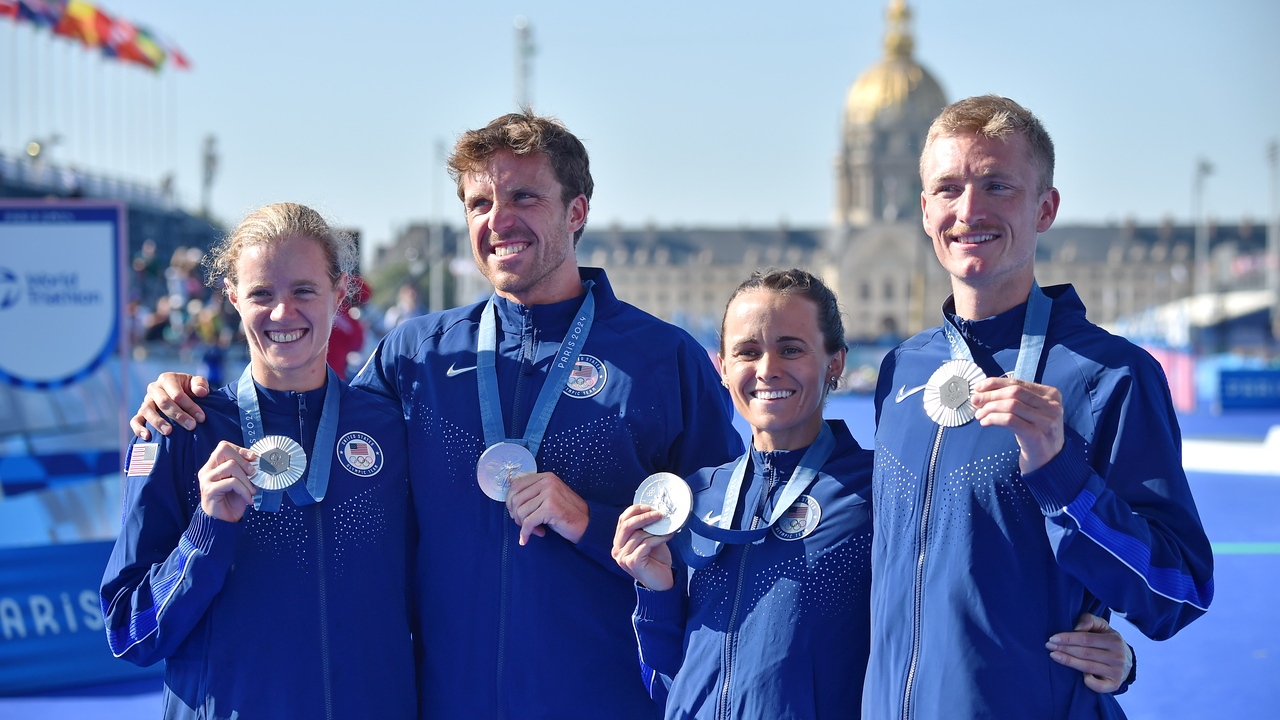
The final Olympic qualification standings from a US-perspective in May 2024 were as follows:
| Position | Athlete | YOB | Total points |
|---|---|---|---|
| 4 | Taylor Spivey | 1991 | 7814.39 |
| 7 | Taylor Knibb | 1998 | 6249.14 |
| 15 | Kirsten Kasper | 1991 | 4756.58 |
| 19 | Summer Rappaport | 1991 | 4637.97 |
| 38 | Erika Ackerlund | 1996 | 3300.34 |
| 39 | Katie Zaferes | 1989 | 3216.06 |
| 40 | Gwen Jorgensen | 1986 | 3156.04 |
| 54 | Gina Sereno | 1995 | 2645.79 |
| Position | Athlete | YOB | Total points |
|---|---|---|---|
| 18 | Matthew McElroy | 1992 | 4669.55 |
| 32 | Morgan Pearson | 1993 | 3527.41 |
| 44 | Seth Rider | 1997 | 2927.94 |
| 78 | Darr Smith | 1998 | 1766.38 |
| 90 | John Reed | 2001 | 1495.88 |
| 92 | Chase McQueen | 1998 | 1465.10 |
But there were three opportunities for US athletes to qualify automatically before that point.
The first of those came at the Olympic Test Event in Paris in 2023 when the first two athletes (per gender) who finish in the top three would earn automatic qualification. If only one athlete finished in the top three, the next best athlete in the top eight will also be picked. And if no athlete reached the podium, then the best finisher in the top eight will auto-qualify.
And Knibb (fifth) and Pearson (sixth, after only bagging a starting spot at the last minute) booked their spots that day.
However there were no additions in the second race which came at the WTCS Grand Final in Pontevedra as no athlete (who hadn’t already qualified) made the podium.
And it was a similar story in the third and last auto opportunity which came at WTCS Yokohama in mid-May just before the window slammed shut.
The criteria there (given one spot per gender had already been booked) was the first US athlete to finish top-three who has not already qualified will earn automatic selection (up to one per gender).
That all meant it came down to the remaining spots being filled by the Olympic Games Athlete Selection Panel via Discretionary Selection. With the wording saying: “The panel considered athletes who can achieve or contribute to a podium result in the individual event and/or to the mixed relay event.
“Performance guidelines considered included performances at WTCS and World Cup races, performance in Super Sprint races, recency of performance, course profile, team composition and team strategy.
Kasper, Spivey and Rider were duly selected, with Rider apparently getting the nod over higher-ranked Matthew McElroy largely on his swim potential for the Mixed Relay – click here for triathlon legend Mark Allen’s deep-dive into that decision.
The start of the 2026 season
A few quick things to note straight away from an American perspective.
As we’ve just mentioned, McElroy was the highest-ranked American male at the end of the 2022-24 cycle but didn’t get a spot and he has now retired and will focus on coaching.
Injuries in the key spell from late 2023 hampered Summer Rappaport’s chances of a second Olympics and the former WTCS winner would ultimately miss out.
She too has called time on her triathlon career, saying: “You can still find me at the pool a lot, but I spend a lot more time talking on the wall than I used to!”
So going into the new campaign – the first WTCS race is in Abu Dhabi on March 28, with two World Cups before then starting with Lanzarote on March 14 – the USA have six women and six men in the top 100 (most are in the higher reaches so should get starts if they want them) of the World Rankings:
| Position | Athlete | YOB | Current points |
|---|---|---|---|
| 4 | Taylor Spivey | 1991 | 3125.85 |
| 21 | Gina Sereno | 1995 | 1439.85 |
| 35 | Gwen Jorgensen | 1986 | 910.98 |
| 36 | Erika Ackerlund | 1996 | 900.87 |
| 58 | Danielle Orie | 1999 | 473.67 |
| 94 | Kirsten Kasper | 1991 | 208.05 |
| Position | Athlete | YOB | Current points |
|---|---|---|---|
| 17 | John Reed | 2001 | 1741.27 |
| 20 | Morgan Pearson | 1993 | 1643.62 |
| 28 | Chase McQueen | 1998 | 1237.62 |
| 36 | Darr Smith | 1998 | 916.49 |
| 37 | Seth Rider | 1997 | 915.92 |
| 61 | Sullivan Middaugh | 2004 | 519.48 |
However it’s clearly very, very early days and there are some notable omissions at the moment.
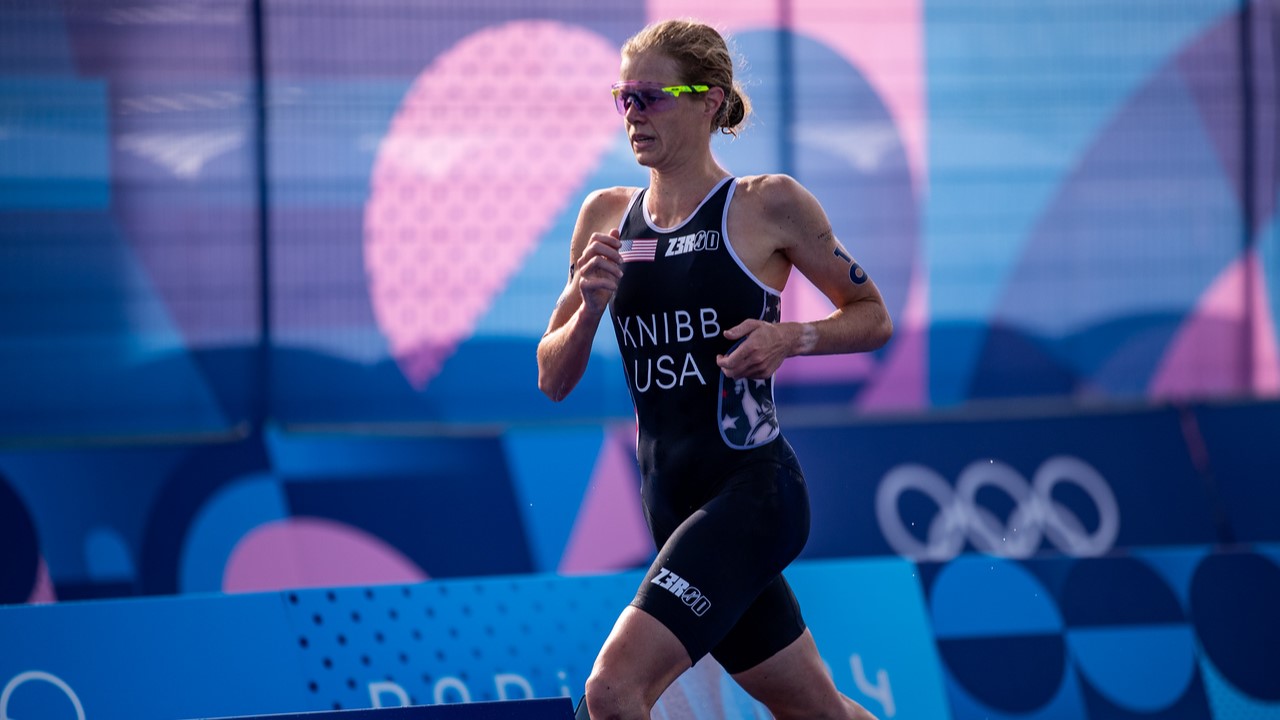
Taylor Knibb’s focus in 2025 was on the IRONMAN World Championship in Kona plus plenty of middle-distance racing and she hasn’t raced short course since the Olympics.
However that will change dramatically this season as she said recently she wants to do “four to six” WTCS events.
Katie Zaferes also isn’t in the current rankings, with the former World Champion having given birth to her second child last July.
So there remains incredible strength in depth on the women’s side. Few athletes have been as consistent at this level in the last decade as Taylor Spivey while 2016 Olympic champion Gwen Jorgensen may turn 40 in April but she’s shot up the rankings since her comeback to the sport and has spoken about wanting “another three good years”, which takes us nicely to 2028.
Gina Sereno, who combines triathlon with her career at NASA’s Jet Propulsion Lab, and Erika Ackerlund have shown they have the talent to get in the mix while Dani Orie is a rising star to watch out for with an impressive NCAA running background.
On the men’s side it again doesn’t look quite as competitive.
And plenty will depend on Morgan Pearson’s focus in the next two years as he made giant leaps at T100 in 2025 and goes from wildcard to major contender in that sphere.
TRI247 analysis – one big cause for concern
The recent Supertri announcement could have huge ramifications for Team USA.
The innovative short-course brand has helped fast-track many a pro career – think Hayden Wilde, Matt Hauser and Jeanne Lehair among others – with the rapid-fire format which leaves no margin for error.
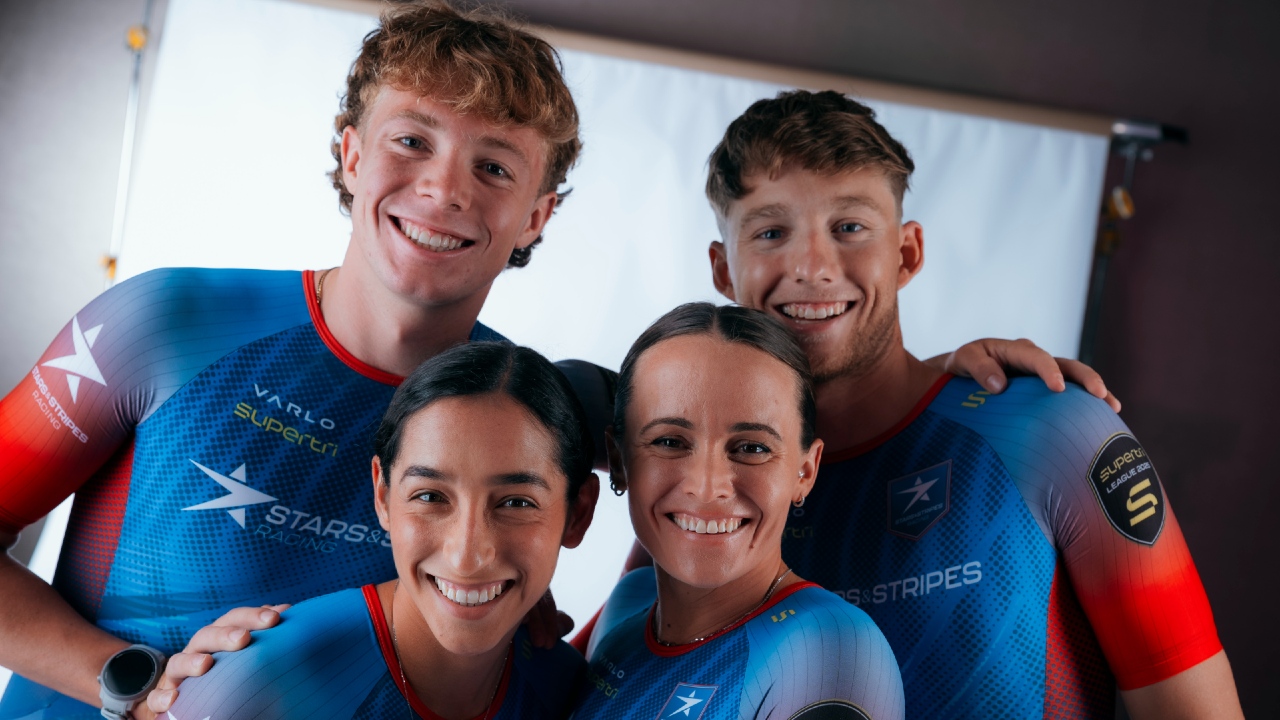
It’s been the perfect platform for future – and current – Olympians to improve their skills and a huge emphasis in the last couple of seasons has been on the Stars & Stripes team.
The “clear mission” statement for them via Supertri less than 12 months ago was “to reignite American short-course triathlon and build a pathway to Olympic success at the LA 2028 Games”.
They were led by Parker Spencer, USA Triathlon’s Project Podium Head Coach and the reigning Olympic Coach of the Year, and it meant that youngsters like Sullivan Middaugh were able to get valuable race experience.
However for all the talk of the $800,000 Pro Series Final – which will be the biggest single payday in pro triathlon in 2026 – there has been a clear pivot to mass participation. There will be three lower-key qualifying races (two of which are in North America) but just the one Supertri format event all season – and the team aspect has disappeared.
Also not happening in 2026 is the Supertri E format which in 2024 saw America’s Chase McQueen excel as he became World Champion.
It remains to be seen what impact all this has for the United States’ male athletes, but less than three years out from LA it looks far from ideal.