

What is VO2 Max?
VO2 max is the maximum amount of oxygen your body can use during exercise. It’s measured in millilitres of oxygen per kilogram of body weight per minute (ml/kg/min).
In triathlon, VO2 max defines your aerobic ceiling. It sets the upper limit for how hard you can go across swim, bike, and run before fatigue forces you to slow down.
Higher VO2 max = greater capacity to produce energy aerobically.
What VO2 max actually represents?
VO2 max is not just “fitness.” It reflects how well your body can:
- Take in oxygen (lungs)
- Transport oxygen (heart and blood)
- Use oxygen in muscles (mitochondria)
- It’s a system-wide measure of endurance capacity.
Why VO2 max matters in triathlon?
It sets your performance ceiling
Every intensity zone, easy, tempo, and threshold, is a percentage of your VO2 max. When your VO2 max increases, your threshold pace rises, your race pace becomes more sustainable, and you’re able to produce more power at the same perceived effort.
It improves speed at all distances
Even in long-course racing, VO2 max matters. In Olympic distance, it directly impacts race pace; in 70.3, it raises your sustainable power and speed; and in IRONMAN, it improves efficiency at lower intensities. A higher aerobic ceiling makes submaximal efforts feel easier.
It enhances recovery between efforts
Triathlon isn’t perfectly steady. Swim starts often include surges, followed by variable efforts on the bike and pace changes on the run. A higher VO2 max improves your ability to recover from these efforts quickly, helping you maintain control and consistency throughout the race.
It supports better race execution
Athletes with a higher VO2 max can handle pacing errors more effectively, maintain form under fatigue, and finish stronger in the later stages of a race. It provides a larger physiological buffer, creating more margin for mistakes without a significant drop in performance.
VO2 max vs threshold: what matters more?
VO2 max is your ceiling. Threshold is how much of that ceiling you can sustain.
- VO2 max = potential
- Threshold = usable performance
For triathlon:
- Olympic: both are critical
- 70.3: threshold becomes more important
- IRONMAN: efficiency and durability dominate
Key point: Increasing VO2 max is valuable, but converting it into sustainable pace matters more.
Typical VO2 max values in triathlon
Men
- Beginner: 35 to 45 ml/kg/min
- Intermediate: 45 to 55
- Advanced: 55 to 70+
Women
- Beginner: 30 to 40 ml/kg/min
- Intermediate: 40 to 50
- Advanced: 50 to 65+
These are general ranges. Performance also depends on technique, pacing, and efficiency.
How VO2 max is measured?
Lab testing (most accurate)
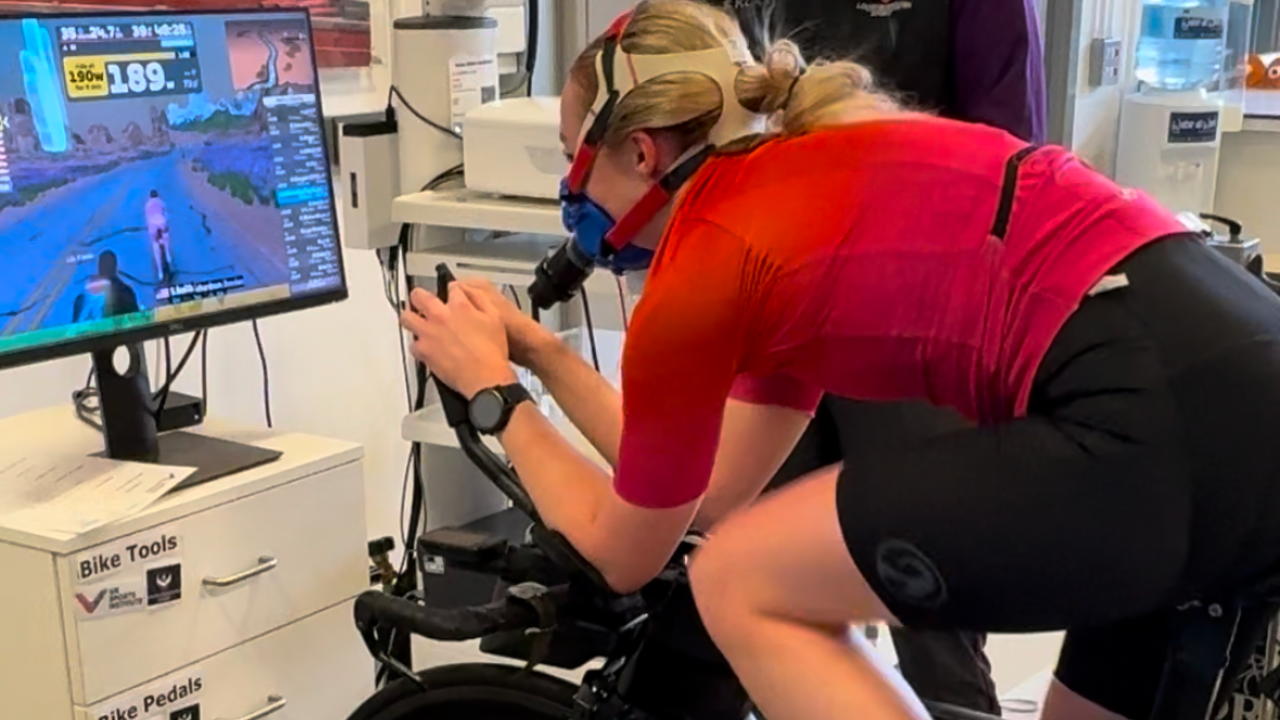
VO2 max can be measured through lab testing using a treadmill or bike, where intensity gradually increases until exhaustion. During the test, oxygen intake and output are directly measured, making this the most accurate method.
Field estimates (practical)
VO2 max can also be estimated through field-based methods such as running tests (e.g. the Cooper test), cycling power data, or smartwatch algorithms. These are less precise than lab testing but are useful for tracking trends over time.
How to improve VO2 max?
VO2 max improves through high-intensity training that stresses oxygen delivery and utilization.
Interval training (primary method)
Examples:
- 4 to 6 × 3 minutes hard (Zone 5) with equal recovery
- 5 × 4 minutes at high intensity
- 30/30 intervals (30 seconds hard, 30 seconds easy)
These sessions push you close to your aerobic limit.
Sport-specific work
Apply VO2 max training across all disciplines:
- Swim: short, high-intensity intervals
- Bike: power-based intervals near max aerobic output
- Run: track or hill intervals
Consistency over time
VO2 max responds to:
- Regular exposure to high intensity
- Progressive overload
- Adequate recovery
Sporadic hard sessions don’t produce lasting gains.
How much can you improve VO2 max?
- Beginners: 10 to 20% improvement possible
- Intermediate: smaller gains (5 to 10%)
- Advanced: limited gains, focus shifts to efficiency
Genetics influence your starting point and ceiling, but training determines how much of that potential you reach. VO2 max improves through high-intensity training that stresses oxygen delivery and utilization, especially structured sessions like these treadmill workouts designed to boost your running VO2 max.
Practical insights for triathletes
Don’t over-prioritize VO2 max
VO2 max is only one part of performance. For long-course racing, pacing and nutrition have a greater impact on outcomes than your absolute aerobic ceiling.
Use it to guide intensity
VO2 max defines your highest training zone and should be used to structure interval sessions. Focus on applying it to training rather than chasing the number itself.
Train all systems
A complete triathlete develops VO2 max for top-end capacity, threshold for sustainable pace, and endurance for durability. Neglecting any one of these limits overall performance.
Place VO2 max work strategically
VO2 max sessions should be used during build phases when intensity is the priority, then reduced closer to race day to manage fatigue and optimize performance.
Common mistakes
- Focusing only on VO2 max – High VO2 max doesn’t guarantee race performance without pacing and efficiency
- Doing too much high intensity – Excessive intervals lead to fatigue, poor recovery, and plateau
- Ignoring discipline specific needs – VO2 max differs across swim, bike, and run. Train each separately
- Chasing inaccurate data – Wearables provide estimates, not exact values. Focus on trends, not single numbers
Simple checklist
To improve VO2 max effectively:
- Include 1 to 2 high intensity sessions per week
- Target efforts near maximum aerobic capacity
- Recover properly between sessions
- Maintain consistency over months
- Balance with endurance and threshold training
What actually drives performance?
VO2 max sets your ceiling, but race outcomes depend on:
- How efficiently you use oxygen
- How long you can sustain effort
- How well you pace and fuel
VO2 max creates potential. Execution determines results.
Final Takeaway
VO2 max defines your aerobic capacity and influences performance across all triathlon distances. Improving it increases your speed potential, but real gains come from combining it with threshold, endurance, and race execution.
Train it, but don’t rely on it.