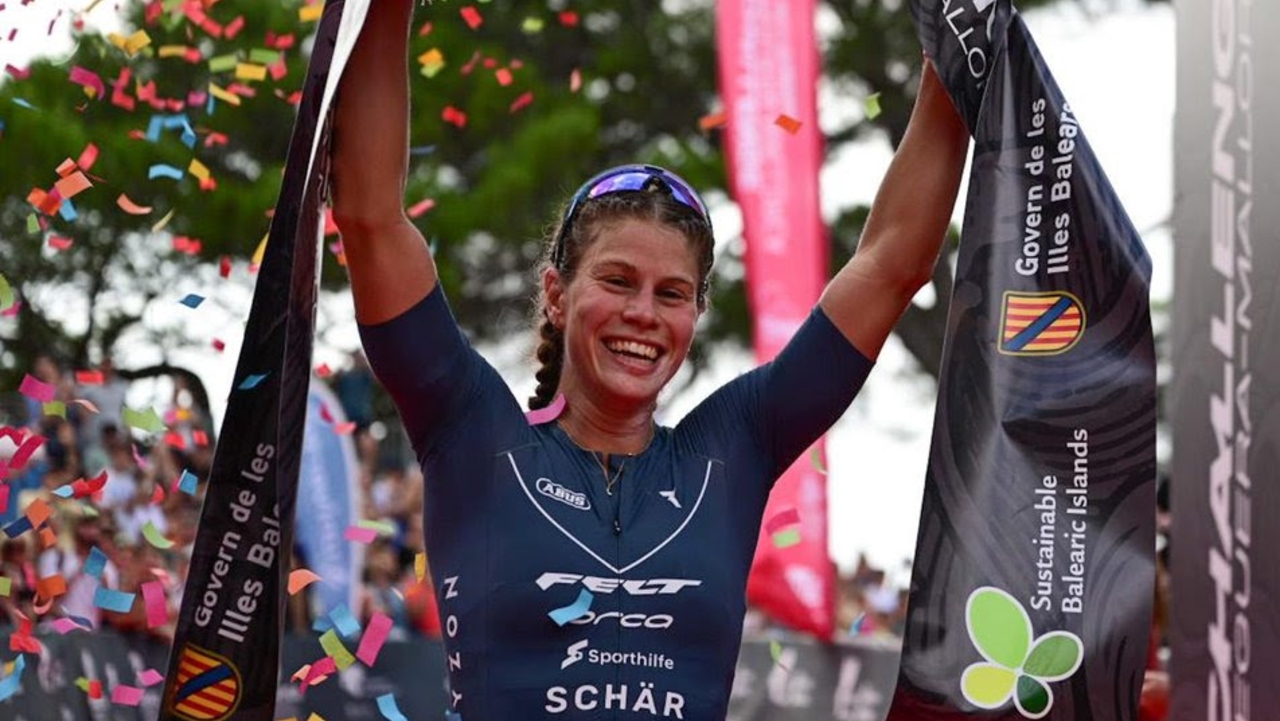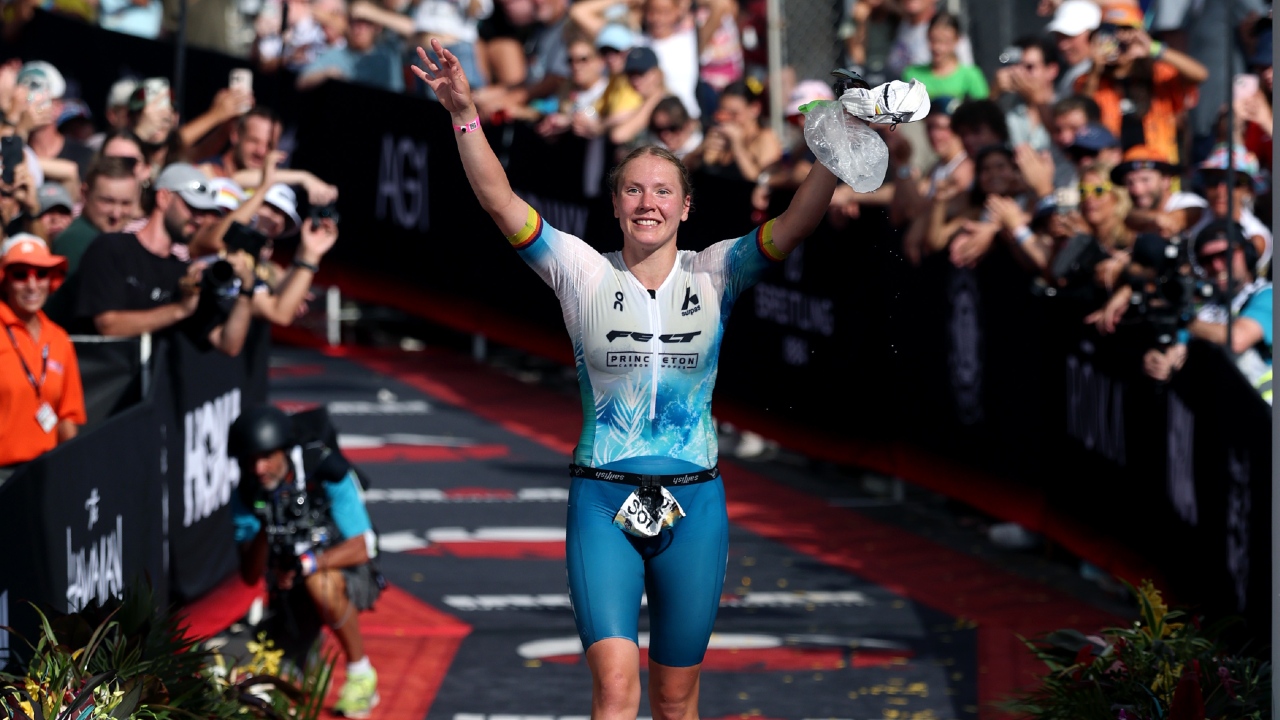




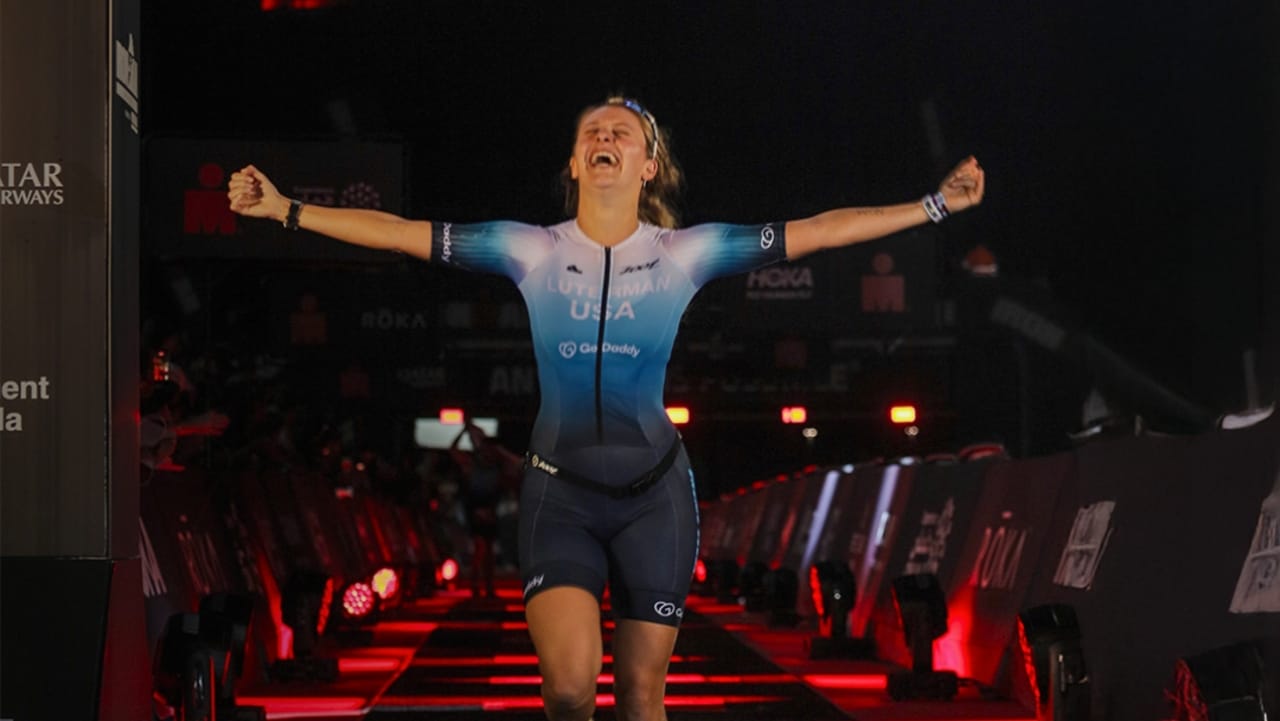
When Ariana Luterman crossed the finish line at IRONMAN Barcelona recently the time on the clock was just under 12 hours after she had started.
But the journey to that point was way, way longer and genuinely life-transforming.
The odds were massively against the now 25-year-old from Texas even making the start line, let alone the finish. For in 2023 she had spent a year bedridden with a mysterious illness no doctor could diagnose or treat. By August, she faced the possibility she might not survive. But instead of asking “What if I die?” she asked herself, “What if I live?”.
Determined to reclaim her life, she applied to attempt a Guinness World Record for the fastest female combined race time to complete a full IRONMAN triathlon on six continents in 12 months. Just months later, she was then diagnosed with skin cancer and underwent emergency surgery near her knee, leaving her unable to walk for a month. Still battling her undiagnosed illness, Ariana decided to take her life into her own hands – researching, consulting family friends, and ultimately devising a ‘Hail Mary’ treatment plan to save her own life.
On the same day insurance approved her treatment, Guinness World Records approved her record attempt and by January 2024 her fever broke and she began to heal. That October, she completed her first full IRONMAN in Sacramento, California, launching her Road to Six journey around the world.
That journey would take her to Western Australia, South Africa, Brazil, Japan and finally Barcelona in October 2025, since when we’ve caught up with her to find out more about her remarkable story.
‘Closure and rebirth’
TRI247: Ariana, congratulations on your record-breaking achievement. When you crossed that finish line in Barcelona and realised you’d completed six full IRONMAN races across six continents well inside the record time, what was going through your mind in that moment?
When I crossed that finish line in Barcelona, it felt like time folded in on itself – like every version of me from the last two years suddenly met in the same place. From the outside, it looked like a normal finish line: crowds, music, lights, a medal. But inside, everything went quiet. Immensely quiet. It was the kind of silence that only comes after surviving something you weren’t sure you’d make it through.
My first thought wasn’t about the record – it was about the girl I used to be. The one in 2023 who couldn’t walk to the mailbox. The one who genuinely wondered if she’d ever get her life back. I felt this wash of grief for her, but also a fierce protectiveness.
Then came awe – awe that my body had become a place I could trust again. Awe that fear and doubt, which lived in me for so long, didn’t get the final say. Awe that I kept showing up even when I didn’t believe I deserved to.
And woven through all of that was an overwhelming, humbling gratitude. For my parents. My friends. My mentors. My coaches. The people who held up belief when mine cracked. It didn’t feel like I crossed alone – it felt like I carried an entire village to that finish line, and they carried me right back.
But the deepest feeling was surrender. A sense that these six races weren’t conquered – they were received. That I didn’t muscle my way through them; I was guided, lifted, reshaped by them. Every setback, every breakdown, every moment I whispered, “I’m scared, but I’m doing it anyway,” lived inside that one step across the line.
Crossing that finish line wasn’t triumph. It was closure and rebirth. It was the exact moment I understood I didn’t just complete a world record – I became someone I never imagined I could be.
You’ve described your journey as beginning not with a goal to break a record, but with a question – “What if I live?” Can you take us back to that turning point and explain how that mindset shift changed everything for you?
That shift was simple, but life-altering. For months, my entire world had shrunk to four walls – my bedroom, my bathroom, my bed, and the inside of my own fear. My body felt like a stranger. Some days it felt like an enemy. I kept being told my health was fine, but nothing about my life was normal. I was 23 years old and planning my days around what I could endure, not what I could do.
At my lowest, I started making decisions like someone who wasn’t planning on a long future. I even wrote my own obituary because it felt practical.
One night, in the quiet of all that fear, something unexpected happened. A small, defiant thought: “But…what if I live?” There was no dramatic breakthrough or epiphany. Just a single thought that cracked open a door I was sure had been sealed shut. It didn’t give me certainty – it gave me permission to imagine possibility.
That question became a seed. The seed became hope. Hope became curiosity. Curiosity became action. And action turned into six races across six continents.
People see the world record and assume that was the goal. It wasn’t. I didn’t start this journey wanting to break anything. I started it wanting to live again – to become someone strong enough, grateful enough, alive enough to even attempt something that once felt impossible.
The record was never the point. Becoming the kind of person who could chase it – that was the transformation. And it all began with the smallest, most powerful question I’ve ever asked myself: What if I live?
Trust yourself
During that year of illness when you were bedridden and searching for answers, what kept you holding on to the possibility of recovery when so many medical professionals couldn’t help? And what did that process teach you about self-advocacy and trusting your instincts?
When you’re sick for that long – really sick – you learn who you are in the dark. You also learn that no one is coming to save you.
I kept holding on because… I didn’t know how not to. Even at my sickest, there was this tiny part of me that refused to accept “we don’t know what’s wrong” as the end of the road. I kept thinking, “Bodies don’t just break for no reason. There has to be something to fix.”
Every time a doctor shrugged, I researched more. Every time a treatment failed, I tried another angle. I became my own experiment. My own advocate. My own detective.
It taught me the most important lesson I’ve ever learned: If something feels wrong in your body, trust yourself even if no one else does.
Had I listened to the dismissive answers, I wouldn’t be here. Had I waited for permission to fight, I’d still be in that bed. I learned that self-advocacy isn’t being “difficult” – it’s being alive. And sometimes the only expert who truly understands what’s happening is you.
You not only battled a mysterious illness but also skin cancer – and yet still committed to a gruelling endurance challenge. How separate were the illnesses from the endurance challenge, or did having a goal help with your recovery?
They were separate chapters of the same book. My illness didn’t make me choose a gruelling endurance challenge. My melanoma diagnosis didn’t make me chase a world record. But recovering from both changed the meaning of the endurance challenge entirely.
Before I got sick, triathlon was performance. Competition. Achievement. After being sick, triathlon became healing. A way to build trust with my body again and a way to reclaim my life.
The world record didn’t save me. But having a North Star – something bigger than my symptoms, bigger than the fear – gave me a reason to fight for my life when it would’ve been easier to surrender. In a weird way, the challenge was an anchor. A reminder that I wasn’t done yet.
So yes – this endurance challenge helped me heal. Not because it fixed anything physically at first, but because it gave me back a future I thought I’d lost.
Rebuilding from the ground up
Once you were finally able to train again, how did you rebuild your fitness and confidence after so much time away from sport – both physically and mentally?
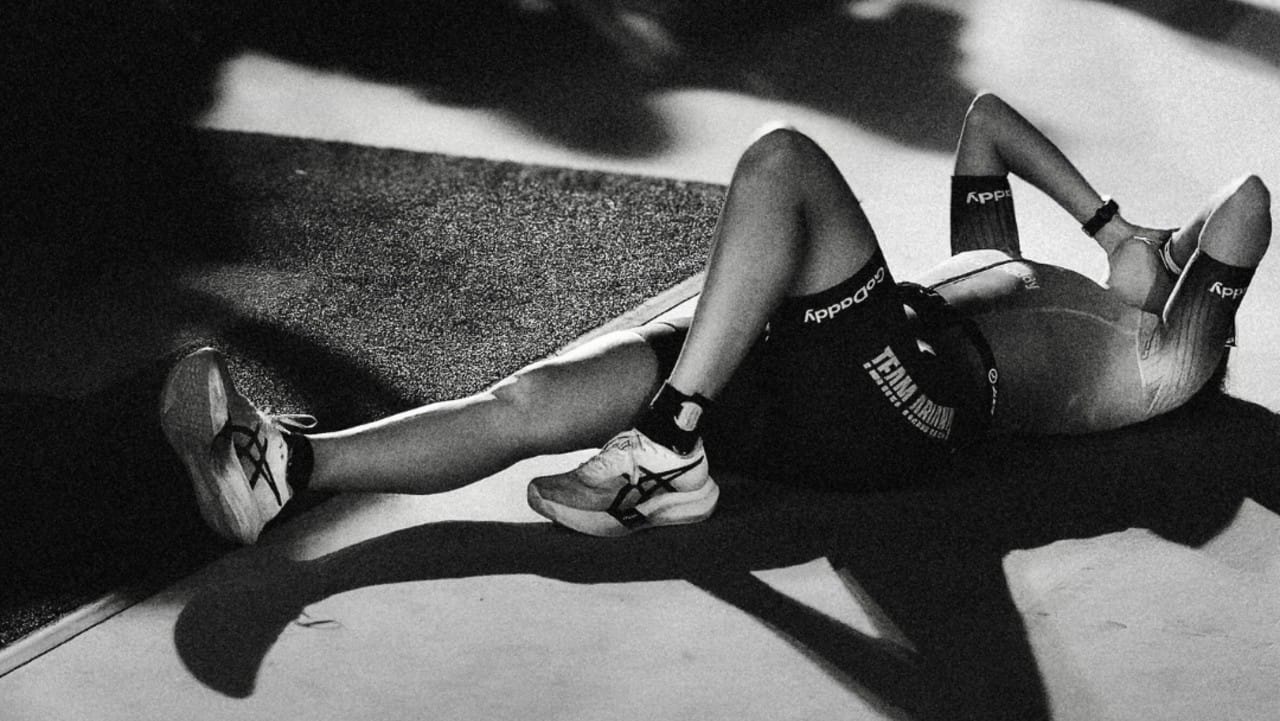
Rebuilding didn’t feel like a return to sport – it felt like a return to myself. My first workout wasn’t anything special. It was walking around the block and needing to sit down afterward. My first swim back felt foreign – like I had forgotten how to be an athlete. My first bike ride was 20 minutes, and I cried on the side of the road – not because it was hard, but because I was finally moving again. That was the throughline: I was fueled by gratitude. Even when things weren’t working, even when it was humiliatingly slow, I was just grateful to try.
The hardest part wasn’t the training – it was trusting my body again. After a year of being terrified of my own physiology, pushing myself felt like walking back into a room that used to be on fire. And nothing about the comeback was smooth.
Training for full Ironmans with a gut that rejected every high-carb drink and gel felt impossible. So I got resourceful. I worked with a nutritionist and built my own high-carb mix from scratch. I made homemade protein bars, I relied on rice cakes, maple syrup packets, honey sticks, mashed potatoes on long rides – anything my stomach could tolerate. I rebuilt my fueling strategy the same way I rebuilt my strength and confidence: step by step, grateful for every little win.
Jason [Lentzke], my coach, rebuilt me physically from the ground up. We didn’t chase volume; we rebuilt a body. We started with strength and stability – waking muscles back up, re-patterning movement, teaching my system how to tolerate stress again. Then we layered in easy aerobic work, embarrassingly slow but steady. Long sessions came when my hormones were stable, my recovery was solid, and my nervous system felt safe. Rest days weren’t optional. Health wasn’t a chapter — it was the foundation.
And somewhere in that process, I stopped asking, “Can I really do this?” and started waking up genuinely excited to try. Training wasn’t punishment or pressure – it was permission. I was so grateful to be moving again. I’ll never forget the first time I worked up to a six-hour bike ride… I was giddy. Who gets excited about six hours on a bike? Someone who thought she might never ride again. Gratitude built my confidence.
The logistics of six IRONMAN races on six continents in a year must have been immense. Were there any particular races, travel moments, or emotional highs and lows that stand out most vividly to you?
The logistics were… wild. People see the finish lines, but they don’t see the colour-coded spreadsheets, the airport meltdowns, the time-zone delirium, the lost luggage, the medical scares, the visa forms, or the four different currencies in my backpack at once. Doing six IRONMAN races on six continents in one year wasn’t just physical — it was a year-long game of emotional and logistical Tetris.
Six incredible tests
Each race had its own personality, its own challenge, its own moment that etched itself into me. After every finish line, I named the race according to the part of me it tested – each one becoming its own story.
California was the “Soul Test” – my first IRONMAN ever. But I wasn’t nervous. I remember standing on the start line with tears already in my goggles because just getting there felt like I’d already won. I raced with an intense injury, limping for 13 miles on a seized IT band, and crossed the finish line realizing I was far stronger than I’d ever given myself credit for. That race tested my soul.
Western Australia was the “Surrender Test” – 4–6 foot waves, crazy winds, a random rainstorm, and jet lag so heavy I couldn’t tell you what day it was. My bike and suitcase went missing and miraculously showed up the day before the race. And yet, it was the most peaceful race I’ve ever done. There was something freeing about surrendering to everything I couldn’t control.
South Africa was the “Solo Test” – at least that’s what I thought. I travelled alone, but ended up more supported than ever. I made friends with local triathletes, coaches, and families. One family invited me into their home for a pre-race meal, and then surprised me on the course with posters and cheers. I arrived alone; I left with a community.
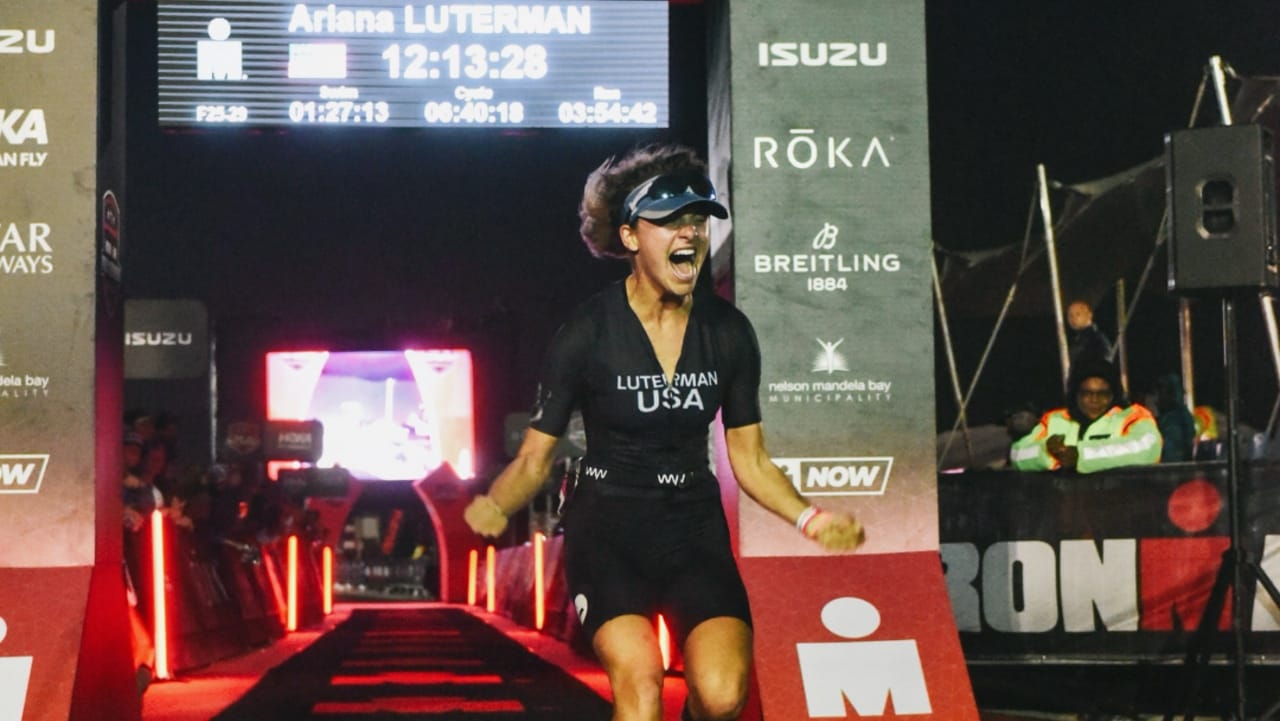
Brazil was the “Scare Test” – leading into this race, everything cracked. My hormones were tanking, my body was fighting back, and mentally I was unravelling. I had to release the idea of being invincible. I ended up not training for six weeks. And ironically, that softness made me stronger — I PR’d by 33 minutes. It was the race that showed me rest isn’t failure; it’s part of the process.
Japan was the “Selfless Test” – the race where my “why” changed. I was over 600 days into this journey, and the burnout was real. I couldn’t run for myself anymore – so I ran for everyone who had carried me to that point. My family. My coach. The people who followed the journey. The girl I used to be in that dark bedroom in 2023. And the future kids I hope will know this story. This race re-anchored me.
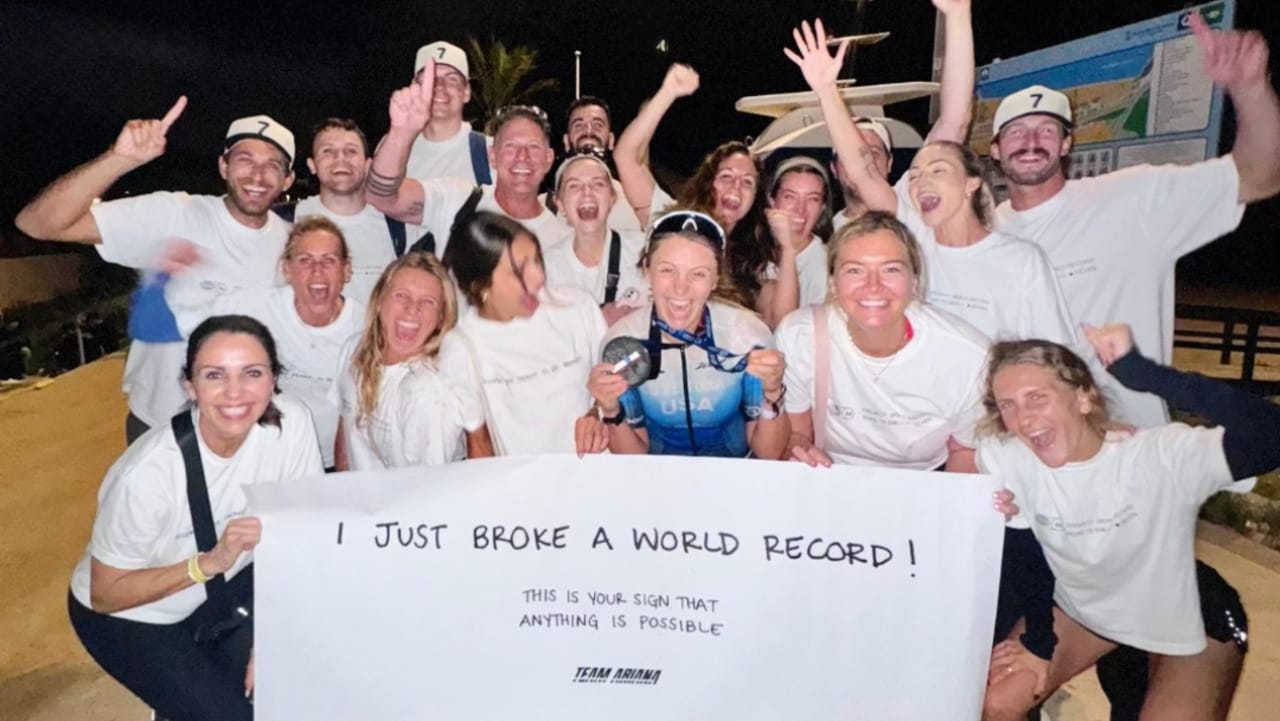
Barcelona was the “Summit” – the final race, where everything converged. Crossing the finish line, the record wasn’t even on my mind. What hit me was the montage of everything it took to get there: the setbacks, the 4am alarms, the fear I carried but moved through anyway. Twenty-five of my closest friends and family flew across the world to be there. The night before, I tossed and turned, terrified I didn’t have it in me. My body hurt. I was exhausted. But they believed so fiercely in me that it reminded me to believe, too. I fell to my knees and cried because I didn’t crumble – I transformed. And I knew it.
The emotional highs were euphoric: riding along the Indian Ocean at sunrise… hearing Japanese spectators shout my name… watching my dad cry at the finish line in Spain.
The lows were just as real: nights alone in hotel rooms, panic attacks in foreign airports, the fear that my body might give out, and the constant whisper: Can I really do this?
But here’s what I learned: This world record wasn’t earned on race day. It was earned in every moment I didn’t quit. And the real victory wasn’t the title – it was who I became along the way.
Every continent was a different version of me learning how to live again. Every race was a test. And together, they became the story of my becoming.
Many endurance athletes talk about racing as a form of meditation or healing. Did this project change your relationship with triathlon and with yourself?
Completely. This project didn’t just change my relationship with triathlon — it changed my relationship with myself.
I’ve been racing since I was seven years old. For most of my life, triathlon was simply something I did – a sport I trained for, a routine I followed, a world I grew up in. But when I dusted off my bike after six years away… it felt different. I wasn’t returning to a sport. I was returning to a part of myself I thought I’d lost.
Over the course of this journey, triathlon became a mirror. It reflected back every part of me I had avoided or outgrown or never truly understood – my fear, my resilience, my loneliness, my capacity, my limits, my strength. It forced me to see who I really was beneath all the labels and expectations.
It also became therapy. There’s something about moving your body for 8, 10, 12 hours straight that strips everything away – ego, noise, distraction. On those long race days, you meet yourself without armour. You face the parts of you you’ve ignored. You learn what you believe when everything hurts and quitting is the easier option.
Triathlon used to be an activity. It became a relationship – with my body, with my mind, with that seven-year-old girl who fell in love with the sport, and with the version of me who needed it to find her way back home.
This journey didn’t just reconnect me to triathlon. It reconnected me to myself.
You’ve said your journey is about more than a record – it’s about helping others believe they can overcome the impossible. What message do you hope someone who’s currently struggling will take away from your story?
I hope they understand that you don’t have to feel strong to choose strength. I was terrified when I started this journey – terrified I’d fail, terrified my body wouldn’t hold up, terrified I wasn’t the person I used to be.
But I took one shaky step, and then another, and that’s what changed my life.
So if someone is in a dark season right now, I want them to hear this: You are not too late. You are not too broken. And you don’t have to climb the whole mountain today. Just choose the next step. That’s how you build belief. And one day you’ll look back and realize you became someone you never thought you could be.
Finally, after everything you’ve been through and achieved, what’s next for you – both as an athlete and as a person? Do you already have another dream or challenge forming in your mind?
As a person, my next chapter is about impact. I’m pouring into my coaching program, my book, my documentary, my speaking – all the work that helps other people excavate their own buried potential. I want to teach people how to access belief. Not motivation, but the kind of anchored, durable belief that changes the trajectory of a life.
As an athlete… Do I have another big dream? Yes. Absolutely. But I’m letting it form slowly.
I’m in that beautiful in-between right now – the space where you integrate what you’ve done and decide what mountain is truly worthy of your next climb. I don’t want to rush that process. I want the next dream to choose me the way this one did.
And something in me knows this much: The next chapter will be even bigger – not because of the achievement, but because of who I’m going to become to reach it.