



This time last year we speculated whether the 2:30 barrier for the marathon in a men’s full-distance triathlon race would finally be broken in 2025.
Olav Aleksander Bu, who helped mastermind the ‘Norwegian Method’ as the likes of Kristian Blummenfelt and Gustav Iden rewrote the triathlon record books, joined us and left us in little doubt it would happen sooner rather than later.
He told us: “I think it will stabilise for the top men probably somewhere around 2:25 to 2:30 in let’s say five or so years time.”
Three-time IRONMAN World Champion Patrick Lange had gone closer than anyone to the mark when he registered 2:30:27 at Challenge Roth in 2023 but in 2025 the glass ceiling was smashed when Manoel Messias clocked a 2:26:50 at IRONMAN Brazil on what was his full-distance debut.
Matt Hanson would then add a 2:28:03 at Challenge Roth and there will surely be others in 2026.
But could this year see an even more mythical ‘barrier’ broken?
Is the eight-hour barrier about to fall?
For more than a decade, one performance stood almost untouched as the gold standard of women’s long-distance triathlon, which is raced over a 3.8km swim, a 180km bike and then a 42.2km marathon run.
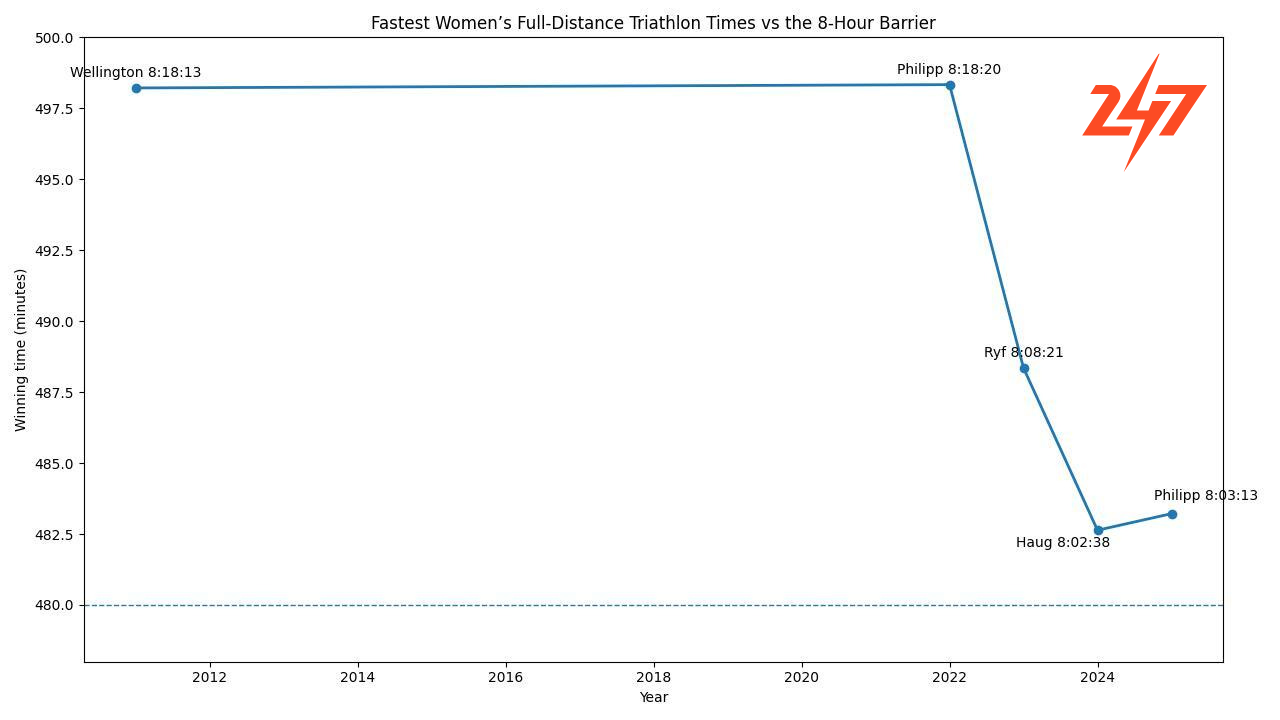
In 2011, Chrissie Wellington produced a race for the ages at Challenge Roth, stopping the clock at 8:18:13 – a time so far ahead of its era that it would remain unbeaten for the next 11 years.
RELATED CONTENT: The fastest-ever full-distance times
Between 2011 and 2022, the record didn’t shift. The closest anyone came was Laura Philipp, who finished just seven seconds shy with an 8:18:20 at IRONMAN Hamburg in 2022.
Then, suddenly, everything changed.
A record that finally started to move
In 2023, Daniela Ryf didn’t just edge past Wellington’s mark – she obliterated it. Her 8:08:21 at Challenge Roth marked a seismic shift in what was considered possible in women’s full-distance racing.
One year later, the bar dropped again.
Back on the Roth course in 2024, Anne Haug delivered a stunning 8:02:38, slicing off another six minutes and leaving the sport staring at a number that once felt untouchable.
And it hasn’t stopped there.
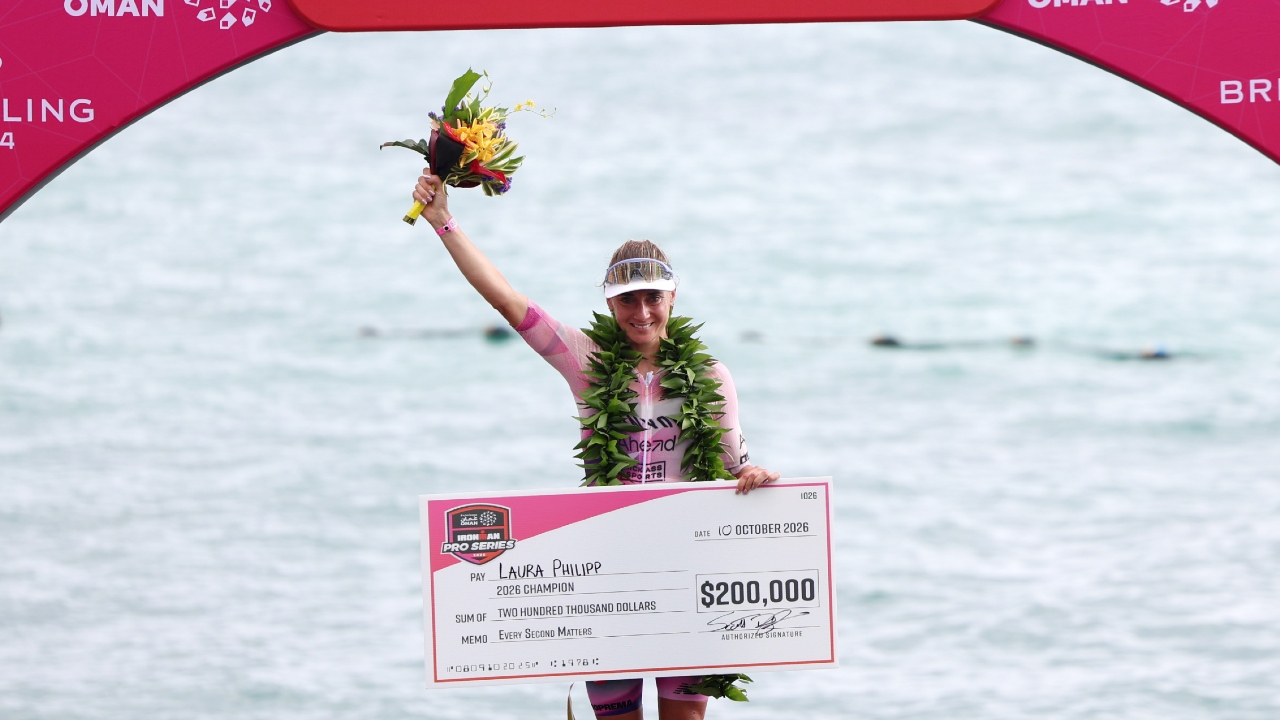
In 2025, Laura Philipp underlined just how deep the current field now is, clocking 8:03:13 at IRONMAN Hamburg – the second-fastest women’s full-distance time ever recorded, on a different course, in a different race. And one in which the distances through transitions are massive.
The conditions weren’t great either and speaking afterwards, Philipp said: “Hamburg, if you want us to go sub-eight, you have to do something about the long transitions!”
Why sub-eight is no longer a fantasy
For years, breaking eight hours in a women’s full-distance triathlon felt a world away.
Now, it’s a matter of minutes, not tens of minutes.
The fastest time in history is less than three minutes away from sub-eight, and crucially, it’s not dependent on a single once-in-a-generation performance. Multiple athletes are now operating within striking distance.
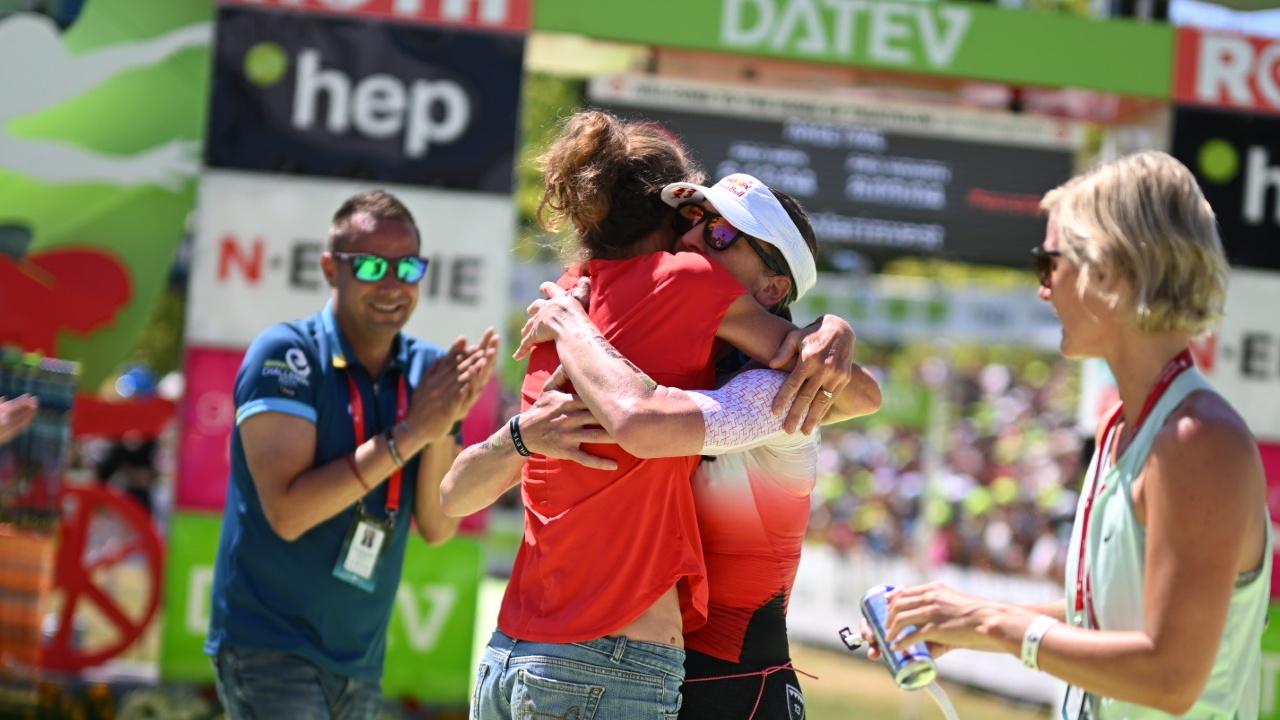
Kat Matthews – who shattered it at the Sub7Sub8 project a few years ago when helped by pacers and an ‘artificial’ environment – pushed Philipp all the way in Hamburg.
And the likes of Lucy Charles-Barclay and relative newcomers Taylor Knibb and Solveig Løvseth, who was crowned IRONMAN World Champion on her debut last October, provide incredible strength in depth even with Ryf and Haug having both retired relatively recently.
Course selection, race conditions and execution will be decisive – but the trajectory is clear.
After more than a decade of no change in that record time, women’s full-distance triathlon has entered a phase of rapid progression. If conditions align in 2026, the sport may finally witness something that once seemed unimaginable.
And as we’ve said, this shift hasn’t come from a single outlier performance. Instead, it reflects a broader evolution in training, technology, nutrition and depth of competition.
The question is no longer if a woman can break eight hours – but when.
Challenge Roth still looks the most likely stage in early July – but Hamburg has to come into the reckoning now too four weeks before, especially if they can tweak those transitions!
Will it open the floodgates?
And when the mark goes, it won’t stop there.
Remember it was only in 2018 that the eight-hour mark was broken at the men’s IRONMAN World Championship in Kona for the first time, courtesy of Patrick Lange.
And yet the last time the men raced on the Big Island in 2024 no fewer than 16 of them dipped under eight hours.