
You know it’s been a tough day of swim-bike-run when even a former Special Forces officer has to seriously tough it out to make it to the finish line.
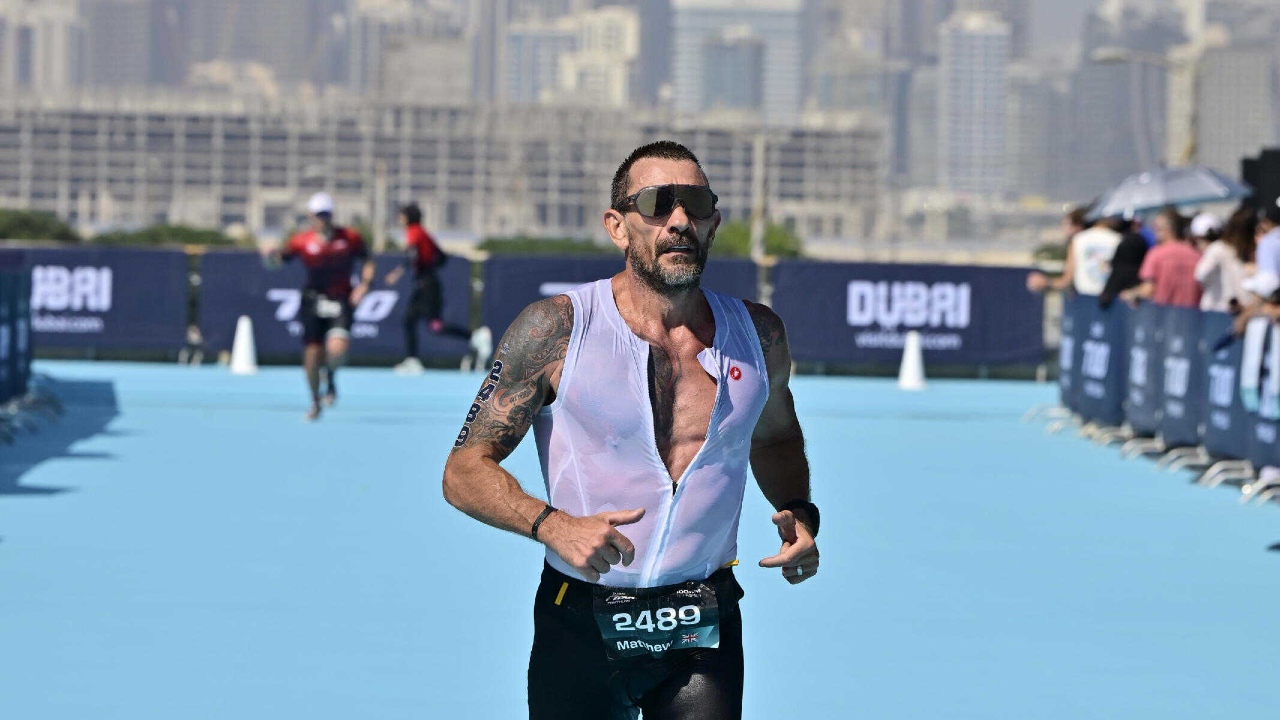
With the sun beating down and the humidity rising, Ollie Ollerton was one of a select field of qualified athletes competing for glory at the inaugural Qatar T100 age group World Championship race. Race week saw over 5,000 amateurs compete in various events, with the qualification-only world championship event hosting 250 athletes from 45 nations.
“You live and learn”
Hayden Wilde might have made it look easy on Friday, but the rest of the pro field attested to just how tough the racing conditions were – with women’s champion Kate Waugh quite literally having to go guts for glory to achieve the win. And based on Ollie’s reaction after he crossed the finish line on Saturday, the age-group field didn’t have an easier time of it.
With a time of 4:40:25 Ollie’s first word to describe the experience was “horrible”, with a laugh and a rye smile that almost every age grouper will be able to relate to. “I had a bad swim, a great bike as always. But I don’t know if it’s these trainers or my feet, but something is wrong!”
It might not have been the performance Ollerton was hoping for, but as he said moments later, “every day is a school day, so you live and learn. It’s not a failure, it’s growth.”
Well and truly bitten by the triathlon bug
Like most of us, Ollie had the full triathlon experience. Going through the pre-race excitement, the mid-race suffering, the immediate reaction of ‘never again’ before quickly asking ‘so when’s the next one!?’ There’s just something about this sport that keeps us all coming back for more, no matter how tough it is out there on race day.
Asked if he’s still all in on triathlon after the race, Ollerton joked: “Give it an hour and ask me again!” Before adding, “No, of course as soon as the pain dilutes it’ll be on to the next goal.”
“What’s not to love about [triathlon]. The T100, what an event they’ve put on. For a pretty new event, it’s kick ass.”
Plans to go the full distance
Most athletes, age groupers and pros alike, are planning a bit of downtime after Qatar T100 to celebrate the end of the season. But Ollerton has no plans to stop anytime soon, and before he’d even stepped away from the finish line zone, he was already starting to chomp at the bit to get back at it.
Asked what’s next, he said: “Back to training! I promised myself I’d do an Ironman, so that’s still [the goal] for 2026. I’ve got another triathlon in January in Abu Dhabi, an Olympic distance. So we’ll try a few things, get the legs sorted out. A bit more training, a bit more transition work – all good!”
“If I do nothing, my world falls apart.”
Ollerton is passionate, and vocal, about the role that physical challenges can play in helping to improve mental health as well as physical health. And as much as it was a bit of a battle out on the race course, he still firmly believes that challenges like the T100 can be a lifeline for people struggling with their mindset.
“This is the answer, I believe, to a lot of people’s issues with mental health. If they sit and do nothing, they become very insular and the walls go up. Before they know it, they’ve become so inhibited.
“Maybe it can just be a tap on the shoulder to say ‘do something different’. People need to be aiming for something bigger, and that would be the answer to a lot of these issues.”
“If I do nothing, my world falls apart.”
“We’re not our age, we’re our energy”
It’s not just mental health that Ollerton is passionate about. He’s also a strong believer that people don’t can defy perceived limits that other things, such as age, might put on them.
“I’m 55 in a few weeks. Age is demonised in our society and a lot of people just accept it. They accept that their stomach is going to grow out to here and they can’t see their feet and they accept that they’re probably going to get ill.”
“I don’t accept that. We’re not our age, we’re our energy!”
Before we let him head off for some well-earned recovery, Ollie acknowledged that people hearing his story might assume that his past as an SAS officer might mean people assume they can’t do what he does. But he was keen to highlight, “I may be a Special Forces Soldier but I bleed and breathe just like everyone else, I’m no different.”