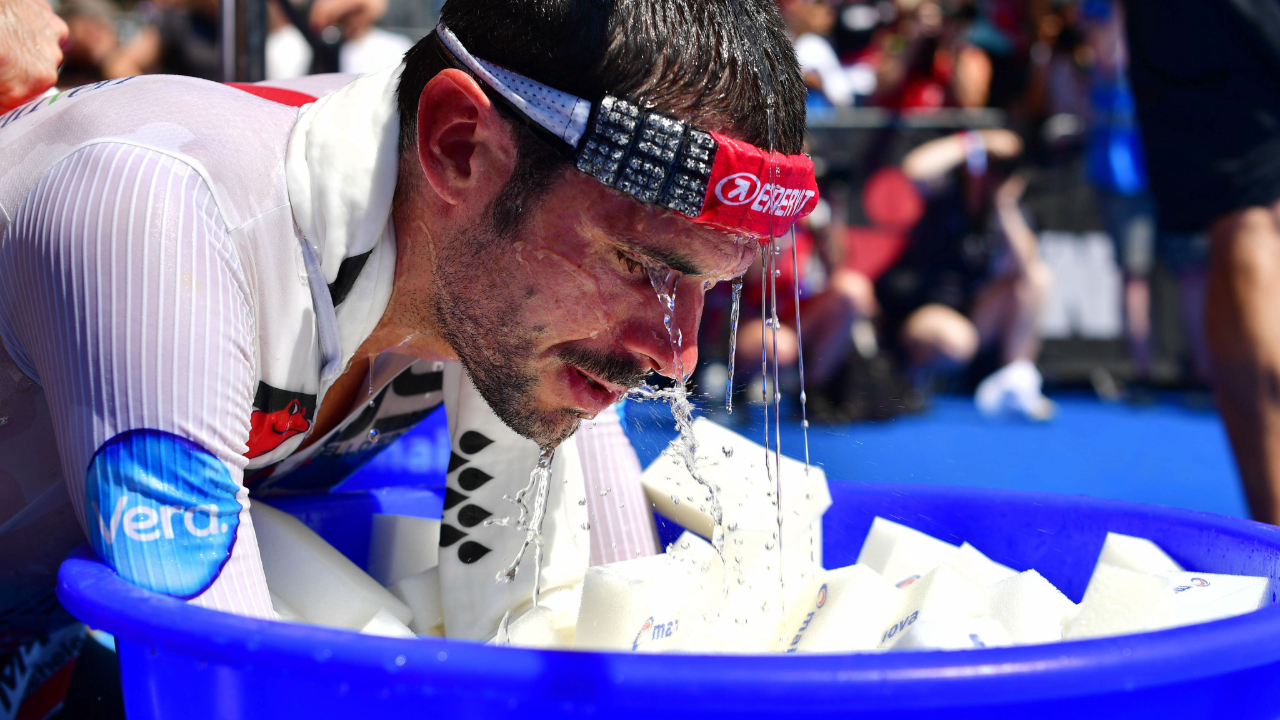





With three races either cancelled or postponed, one reduced in distance and others requiring additional cooling and hydration stations, this searingly hot summer of record-breaking temperatures has undoubtedly left its scorch marks across Europe’s busy triathlon calendar.
Host cities, race organisers and the athletes themselves have all been hit hard as the series of unrelenting heatwaves continues to deliver conditions deemed too dangerous for mass endurance events.
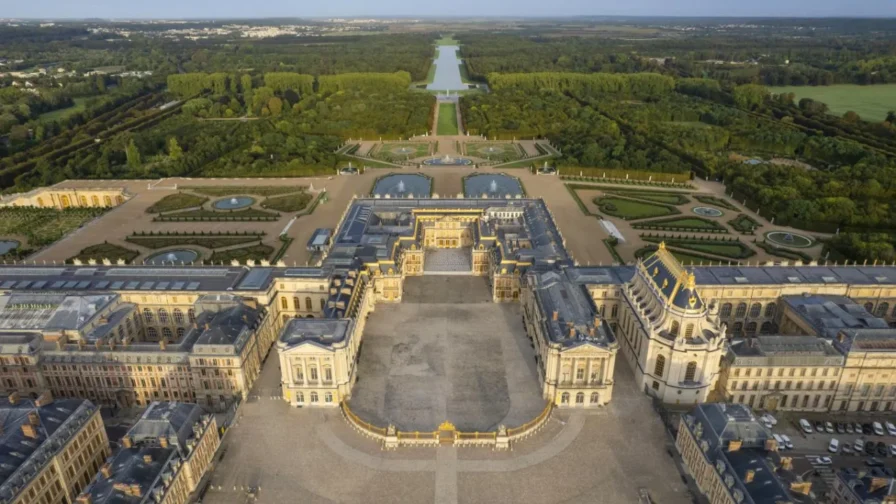
The disappointment of IRONMAN being forced to cancel both its full-distance and 70.3 races in Nice – while also reducing the bike and run legs in Frankfurt – was then followed by the frustration of having to postpone its new landmark race at the Château de Versailles.
Does triathlon need new heat rules?
Of course, the 70.3 World Championships will be held in Nice next month, and there are still many key races in the T100 and WTCS programmes set for Europe. Reports that the developing El Niño could become exceptionally powerful – and potentially contribute to further global temperature extremes – are therefore unlikely to provide much reassurance.
With further races across the triathlon spectrum also having to provide additional support for athletes competing in such torrid temperatures, it is little wonder that race organisers have already started looking at arranging events outside the height of summer. The disruption has intensified the debate over whether universal triathlon heat rules are now needed to protect athletes and give organisers greater clarity.
While Versailles has been rearranged for Sunday, October 11, Nice was not so lucky, and IRONMAN France Project Director Yves Cordier confirmed that next year’s race would now be moved to September, in part, as ‘a more suitable date with the weather conditions’.
It is a step which could yet be repeated in the coming seasons if, as expected, summers across the continent continue to hit new highs, and local hosts are faced with having to balance the needs of the athletes with the health and safety of their residents.
IRONMAN officials left with no choice
In both of the French cases, it was the local authorities which requested that the races be postponed or cancelled. Their concerns over the impact they would have on regional health and emergency services were completely justified and gave IRONMAN no choice but to follow their lead.
With no official temperature threshold set for the sport, it is left to the individual race bodies to decide whether an event is safe to go ahead or not, and in the case of IRONMAN, that decision is left to the race directors, who are on the ground and very much in the best position to make such a huge call.

Negotiations will have taken place with city officials, emergency services and medical teams to decide whether it was safe to go ahead, whether more aid stations were required, and also whether the local hospitals and first-aid teams could cope should there be a sudden influx of people suffering from heat exhaustion.
In Frankfurt, the answer was ultimately yes, albeit with concessions over shortened bike and run courses; in the case of Nice and Versailles, it was the local officials – the Alpes-Maritimes Prefecture and the Préfecture des Yvelines – who ultimately pulled the plug on both events.
Local host authorities need reassurance
With both calls made very late in the build-up to the events, it left many athletes frustrated, and some irate age-groupers vented their opinions on social media – complaining about the wasted hours of training, the cost of transport and accommodation, and the agony of not being able to complete a full IRONMAN.
Those emotions were entirely understandable, but organisers and local authorities had an overriding responsibility to protect the thousands of age-group athletes due to take part.
IRONMAN deserves praise for the way it has supported its athletes, with the list of options provided to those affected in Nice – including deferment, refunds or being able to race in another event this year – very much welcomed by the age-groupers.
But with fears that extremely hot summers are likely to now be the norm, and with authorities clearly concerned about the impact of having thousands of people swimming, cycling and running through their towns and cities, it seems the time might have come for official guidance, and possibly even regulation.
World Triathlon adopt WBGT system
While there are no official heat restrictions in the sport, World Triathlon did come up with its own heat guidance that – developed ahead of the Tokyo Olympics test event in 2019 – is designed to help organisers, medical teams and athletes manage heat risk.
The ‘Beat the Heat’ programme focuses on heat acclimation, hydration, cooling strategies, pacing and recognising heat illness by setting out a series of five categories using the universally acknowledged Wet Bulb Globe Temperature (WBGT) system.
Rather than simply measuring air temperature, WBGT combines air temperature, humidity, solar radiation and wind, making it a much better measure of heat stress, and is used by the ATP Tour and the Australian Open in tennis, World Rowing and the UCI in cycling.
It is an issue that World Triathlon says ‘is under constant review’, confirming that while its latest guidance remains focused on the ‘Beat the Heat’ WBGT system, the governing body is keeping a close eye on developments to maintain the safety of athletes.

‘A matter of concern for the whole sport’
“This is very much a live topic for us,” a spokesperson said. “Our Medical Committee constantly reviews all available research and data, not only from triathlon but also from other endurance sports, and adapts our approach whenever necessary.
“Athlete safety in high heat is a matter of concern for the whole sport and is always under consideration; it isn’t something that only comes up when a heatwave hits the headlines.”
The current WBGT scale (combining air temperature, humidity, solar radiation and wind) looks like this…
🟢 – Green Flag (Low risk): Anything under 25.7C
🔵 – Blue Flag (Moderate): 25.7C-27.8C
🟠 – Orange Flag (High): 27.9C-30C
🔴 – Red Flag (Very High): 30.1C-32.2C
⚫️ – Black Flag (Extreme): Anything above 32.2C
It is designed so that organisations and athletes can decide whether they need to take action, such as increasing medical staffing, providing additional cooling and hydration, adjusting race schedules or start times, shortening courses where appropriate, and, in exceptional cases, modifying or cancelling the event if athlete safety cannot be assured.
Future-proofing against global warming threat
With air temperatures in Nice, Frankfurt and Versailles nudging 35°C, conditions would likely have produced elevated WBGT readings. Although the precise categories cannot be determined from air temperature alone, the oppressive heat supported the decisions made by officials facing frantic and agonising calls.
And so, with global warming likely responsible for more such summers in the coming years, is it time to make the World Triathlon scale a more official standard? And possibly even add a final category requiring the automatic cancellation of races once a clearly defined maximum WBGT threshold is exceeded?
Would age-groupers be happier knowing that these regulations are in place so they are aware in advance of the criteria and what the potential course of action might be?
A recent poll in the Daily Split endurance newsletter put that very question to its subscribers and saw 82% of them vote in favour of such a move.
One thing is certain: this will not be the final weekend, month or season in which race organisers face such issues. Greater clarity – and possibly regulation – could therefore be welcomed by organisers and athletes alike.