 What is a 1x drivetrain and should you use one for triathlon?


Cast your eyes over the ranks of professional triathletes’ bikes lined up in T1 and you’d do well to spot a front derailleur or double chainring on certain courses.
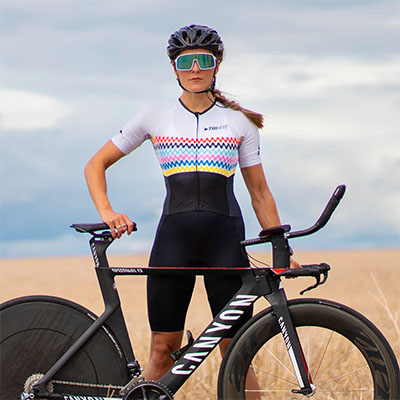
Whether they’re racing aero road bikes or full-on tri bikes, many of the world’s top multisport athletes use a single chainring.
In this article, we’ll explain what a 1x drivetrain is, the rationale behind using one, and if you should consider converting your bike to 1x (pronounced ‘one-by’).
What is a 1x drivetrain?
In a 1x drivetrain, there is just one chainring on your cranks and no front derailleur. In a 2x or double chainring set-up, this shifts the chain between the big and small ring and vice versa. With only one front ring, the front derailleur is redundant, so you can remove it.
Therefore, when you change gear using a 1x drivetrain, you can only move the chain up the cassette (for an easier gear) and down the cassette (for a harder gear). This can make riding a single chainring simpler than using a ‘double’ because you only have to worry about what gear you’re in at the back.
Partly for their simplicity, single chainring set-ups are common on children’s bikes and town bikes. In a more competitive setting, 1x drivetrains became popular on mountain bikes and are now almost default on modern gravel bikes.
What are the benefits of a 1x drivetrain for triathlon?
So should you swap in a single chainring on your road or triathlon bike then? As ever with cycling tech questions, it depends.
Dan Bigham, cycling’s former World Hour Record holder and the technical director of WattShop, says: “It is course dependent, and to some degree, rider dependent.
“In the WorldTour [where Bigham is head of engineering at Red Bull-Bora-Hansgrohe], we have simulation tools to answer this question quickly and objectively on a rider and course basis.
“The answer is it depends on the time and power spent at different speeds, the rider’s desired minimum and maximum cadence limits and their preferred cadence jumps between gears.”
More aero and efficient
In theory, a single chainring for triathlon makes sense. Tight steps between gears are less important than in road racing. Coupled with an appropriate cassette, a 1x drivetrain has adequate range (ie, a hard enough highest gear and an easy enough lowest gear) and improves aerodynamics and drivetrain efficiency to the tune of 3-5W at triathlon race speeds.
Bigham says: “It is likely 1X is a better solution for a lot of scenarios due to reduced aerodynamic drag and mass, which has negligible impact in practical terms though, and potentially increased drivetrain efficiency, although this depends on what chainrings and cassette you are comparing between.”
The aerodynamic benefits of 1x come from losing the front derailleur. These protrude from the frame into the wind and, in an electronic groupset, can be quite bulky.
Drivetrain efficiency refers to the amount of power from the pedals that transfers to the rear wheel, moving the bike forwards. Friction from the chain, chainrings, rear derailleur jockey wheels and cassette causes the losses, ranging from a couple of percent in a best case scenario to upwards of 10%.
He adds: “By keeping gear ratio constant and increasing chainring and cog size, you increase drivetrain efficiency. For example, 56×14 is more efficient than 52×13.
“By increasing chainring size, your time distribution in each cog moves up the cassette which also helps because drivetrain efficiency is nearly constant from the centre of the cassette to the top whereas it drops steeply from the centre of the cassette to the bottom, so you spend less time in those inefficient gears at the bottom of the cassette.”
Straighter chainline
A single chainring can also optimise your chainline, which is how straight your chain runs between the chainrings and cassette. Because the chain moves across the rear cogs as you change gear, the chain is rarely perfectly straight. This skewing reduces mechanical efficiency.
“But this variable is highly course specific so there are scenarios where wider chainlines are more efficient and vice versa, so it’s impossible to generalise here,” says Bigham. “A narrower chainline improves drivetrain efficiency at the top of the cassette at the expense of drivetrain efficiency at the bottom of the cassette. The opposite is true for a wider chainline.”
What are the downsides of riding a single chainring for triathlon?
Despite their popularity in professional triathlon, fewer age groupers have 1x drivetrains.
“We’ve had ten years of SRAM 1x road system and at the beginning I was so excited because I felt like the new athlete would have one less shifter to deal with,” says Quintana Roo design engineer Brad DeVaney. “They wouldn’t have to know the art of shifting a bicycle to avoid cross-ringing, creating excess wear and dumping chains.
“So I thought this would take off like gas and matches and set fire to the industry. But it didn’t.”
While DeVaney sees the benefit of 1x for the “elite athlete who’s looking for that really slim bit of aerodynamics that can be gained by losing a front derailleur”, he adds: “I feel like it’s not superior [for everyone] and some of us will continue to ride 2x systems.”
So why hasn’t 1x universally caught on?
On hilly courses, a 1x drivetrain might not provide enough gear range. Lacking a smaller front chainring to drop down into, you won’t be able to spin up climbs and will probably have to pedal harder and at lower cadence than you’d like.
“For a lot of age-group triathletes a single is not the best choice,” says Clinton Butcher, the founder of EZ Gains, a manufacturer of aerodynamic triathlon components. “Even a good age-grouper would be crazy to run a single on a course like Swansea.”
Lack of range
Single chainrings are popular with UK amateur time trialists. But they are specialist cyclists who go flat-out on courses that are generally shorter and often less hilly than triathlon bike legs, so Butcher doesn’t think their equipment choices are applicable to multisport.
His experience running a 1x drivetrain as an age grouper (“I’d grind up the climbs and come off the bike with burnt out quads then have a bad run”) prompted him to develop a front derailleur guard – a bullet-shaped plastic sheath designed to smooth airflow.
In Silverstone wind-tunnel testing, he claims his brand’s IRONMAN and ITU-legal EZ AFDQ saved 5.8W versus an uncovered 11-speed Shimano Ultegra Di2 derailleur at 50km/h and 4W at 40km/h.
“It gives you the option to run a double on a course without losing many watts,” adds Butcher.
That’s not to say you should cover your front derailleur if you use a double chainring. Not everyone is in the market for a 4-5W saving. Plus, if having an inner chainring enables you to maintain a comfortable cadence on hills, this may end up being quicker than straining up with a single ring. And it could help to save your legs for the run.
Fitting a chainring that’s not designed to be run on its own (for example, the big ring from a 2x set-up) or that isn’t compatible with the rest of your drivetrain will negatively affect chain retention and shifting. But such issues are easy to avoid, as we’ll explain now.
How to convert your triathlon bike to a 1x drivetrain
Your first step should be to choose a compatible chainring. This is easiest for SRAM groupsets because the American brand has pioneered the use of 1x drivetrains for mountain bike, gravel and road cycling. It makes aero 1x chainrings in a number of different sizes and specs to match your SRAM Red or Force AXS cranks, for example.
Shimano and Campagnolo don’t make 1x road chainrings but many aftermarket single rings are compatible with these brand’s cranks. Identify their bolt circle diameter (BCD) and how many bolts they have. For example, Shimano Dura-Ace R9200 are 110BCD and four-bolt. If in doubt, ask your bike shop or online retailer for help finding the right configuration.
Retain your chain
In a 2x drivetrain, the combination of the front derailleur and two chainrings makes chain drops unlikely. But the chain can be less secure with a single chainring. It’s highly recommended to use a 1x-specific chainring. Some triathletes will also fit a chain catcher or guard, to diminish the chances of the chain coming off.
Clutched rear derailleurs are sometimes recommended in a 1x drivetrain as another chain-retention measure. SRAM AXS road rear derailleurs incorporate a clutch but Shimano’s do not. Shimano users could fit the brand’s GRX gravel rear derailleur though.
On the issue of chain retention, Bigham says: “Narrow-wide tooth profiles are incredibly helpful at retaining the chain.
“A clutched rear derailleur can also help to keep chain tension, which is the primary driver of why chains derail. Low tension means less force holding the chain on the chainring.
“Chain guides are merely a safety net for those who are extra precautious.
“I’ve personally never raced with one and have only dropped my chain during a very fast and bumpy descent, where there was no power output so no chain tension, in the 2022 Commonwealth Games TT around Birmingham.”
Chain and shifting adjustments
Depending on how large a chainring you choose, you’ll need to remove one or two links out of your existing chain, or cut a new chain shorter than before. You may also need shorter chainring bolts.
Your front derailleur will be surplus to requirements. In a SRAM AXS groupset, you’ll need the left shifter to change down at the back, but you could remove it from a Shimano 1x groupset.
After converting your drivetrain, it’s likely that you’ll need to adjust your chainline and rear derailleur indexing for optimal shifting. There’s a knack to this, as there is to the tasks above, so head to a quality bike mechanic if you’re unsure how to do it yourself.
How to choose the correct size front chainring?
Because you have fewer gears at your disposal while riding a 1x drivetrain, chainring choice is critical.
Go too small and you’ll spend a lot of time pedalling with your chain at an inefficient angle to the bottom of the cassette and potentially spin out at higher speeds.
Go too big and modest inclines will feel like double-digit gradients as your cadence drops knee-troublingly low.
As a starting point, think about how you use your current gears. Strong riders or triathletes racing flat courses could use a chainring that’s a similar size or even larger than their big ring in a 2x set-up. A safer option, especially on a rolling course, would be a gear somewhere in between your big and small ring.
Gearing equations
Bigham says: “The mathematically correct way to select the right size chainring and cassette – you have to consider them as a pair, since in combination they determine your gear ratios – is to have a simulation tool to do this.
“Since this is beyond the means and resources of most athletes, the simple way of doing it is to calculate, or measure by riding, your lowest speed on your course, which normally falls on the steepest section, and then from your chosen minimum cadence, calculate the gear ratio required for this.
“You then select the largest chainring that enables you to achieve this required gear ratio, which tends to maximise drivetrain efficiency.”
Bigham says to use the following equation:
Gear Ratio Required = Speed in km/h x 7.94 ÷ Cadence in revs / min
Gear ratio = chainring ÷ cog
As an example, let’s take a minimum uphill speed of 15km/h. 15 multiplied by 7.94, divided by a minimum desired cadence of 70 equals a gear ratio of 1.7. You could achieve close to this gear ratio with a 50T chainring and 28t or 30t smallest cog on your cassette.
Alternatively, you could use online software, such as www.gear-calculator.com.
As Bigham alluded to, nothing beats field testing. If your budget stretches to multiple chainrings, buy several sizes and test them in a course recce or on terrain that replicates its profile.