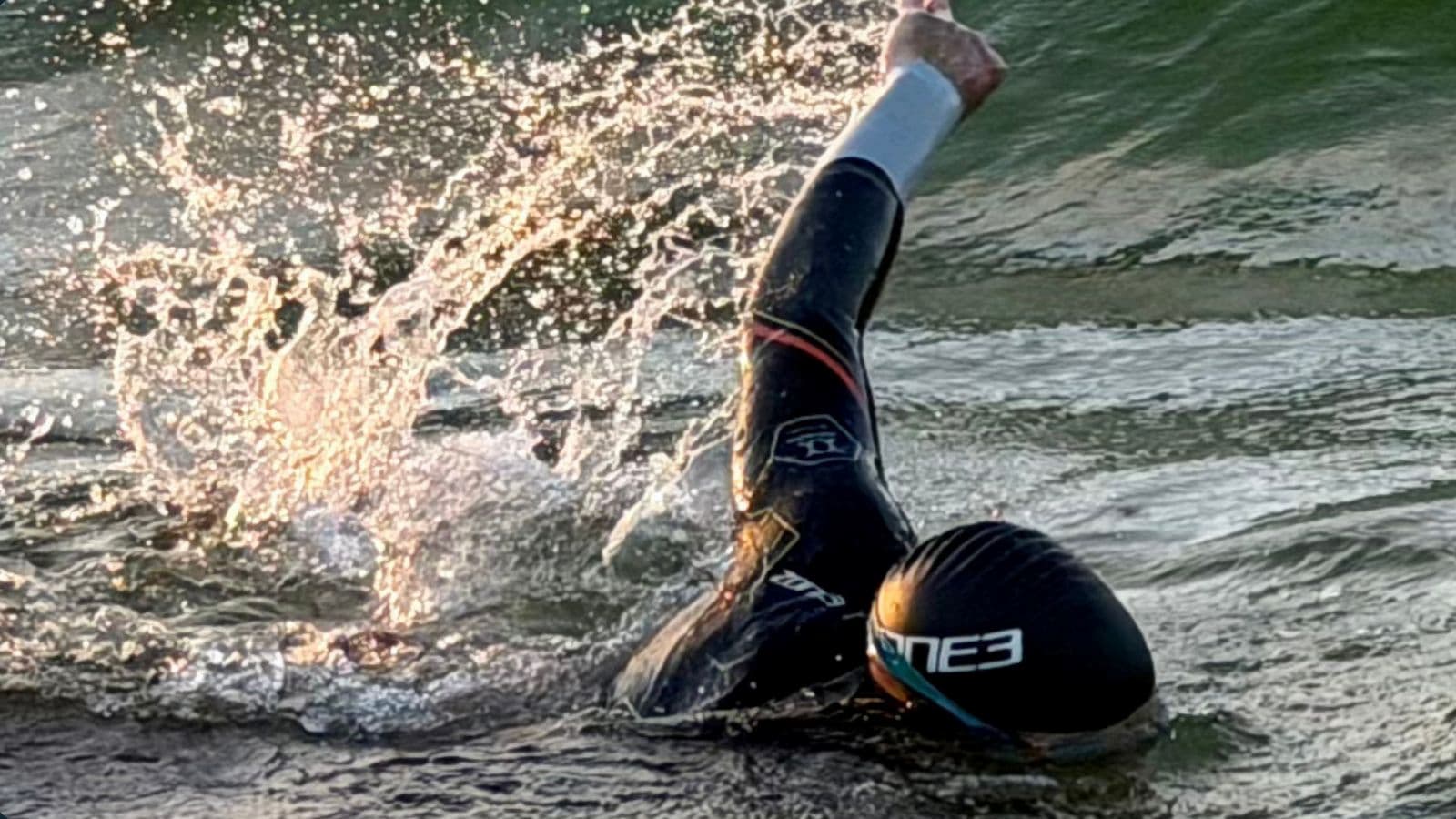


Yes, improving your catch can help you swim faster because it allows your hand and forearm to apply force to the water more effectively. A good catch helps convert each stroke into useful forward movement instead of allowing the arm to slip through the water. The catch is the early underwater phase of freestyle after your hand enters and extends forward. During this phase, the elbow begins to bend and the hand and forearm establish a position from which you can apply pressure backward. A better catch does not mean pulling as hard as possible. For triathletes, the goal is to produce useful propulsion while limiting wasted movement and unnecessary fatigue. Catch technique should work together with body position, rotation, breathing, stroke timing, and overall swim fitness.
In Short
- The catch begins after hand entry and extension.
- The hand and forearm work together.
- Avoid simply pushing water downward.
- Body position affects catch effectiveness.
- Good technique should remain controlled as fatigue develops.
- Drills can improve awareness of pressure against the water.
- A better catch should improve efficiency as well as speed.
What Is the Catch in Freestyle?
The catch is the point where your arm begins establishing useful pressure against the water before the main pulling phase. After the hand enters, the arm extends comfortably forward. The elbow then begins to bend while the hand and forearm move into a stronger position for applying force. The catch is important because simply moving your arms faster does not guarantee greater swimming speed. Improving this phase can contribute to how to increase triathlon swim speed by helping you generate more useful propulsion from the underwater portion of each stroke.
Use Your Hand and Forearm Together
The hand is not the only part of the arm involved in creating propulsion. During an effective catch, the hand and forearm work together to create a larger surface against the water. Think about establishing pressure rather than grabbing or aggressively pulling the water. If the elbow drops immediately and the forearm remains poorly positioned, you may rely too heavily on the hand. The arm can then move backward without creating as much useful propulsion. The exact position varies between swimmers, so avoid trying to reproduce one perfect elbow angle.
What Is an Early Vertical Forearm?
Early vertical forearm, often shortened to EVF, describes a catch position where the elbow remains relatively high while the forearm becomes more vertical. This allows the forearm to contribute more effectively to the underwater stroke. The term can be useful, but it is often misunderstood.
Your forearm does not need to become perfectly vertical immediately, and forcing the elbow into an extreme position can create unnecessary shoulder stress. Develop the movement gradually and stay within a comfortable range.
Technique work should help you move more efficiently, not create pain.
Avoid Pressing Straight Down
A common catch mistake is pressing the hand toward the bottom of the pool. This may create movement without producing much useful forward propulsion. Instead, establish the catch and gradually direct pressure backward as the pull develops. The movement should feel controlled rather than rushed.
Technical practice can be included within what swim workouts improve triathlon performance, allowing you to work on the catch before applying it during longer or faster swimming. Quality matters more than completing large amounts of poorly controlled drill work.
Hand Entry Affects the Catch
A good catch begins before the arm starts pulling. If the hand enters across the body’s center line or reaches into an awkward position, the catch may become more difficult to organize.
- Aim for a relaxed entry followed by a comfortable forward extension.
- Avoid aggressively reaching so far that your shoulder becomes tense.
- A consistent entry can also support better direction in open water.
The same alignment principles involved in why swimming straight matters in open water triathlon can reduce unnecessary side to side movement while improving stroke consistency.
Body Position Matters
You cannot evaluate the catch completely separately from the rest of the stroke. If your legs sink significantly, drag increases. Part of your effort may then be spent compensating for poor body position rather than moving efficiently forward.
- Head position
- Balance
- Rotation
- Breathing
- Kick
all influence how easily you establish the catch. A technically strong catch cannot fully compensate for excessive drag. This is why swimmers should avoid focusing on one small part of freestyle while ignoring the overall stroke.
Rotation Supports the Catch
Freestyle involves controlled rotation of the body.
As your body rotates:
- Shoulder
- Trunk
- Arm
work together during the underwater stroke. Too little rotation can make the catch feel restricted, while excessive rotation may disturb alignment. Breathing can also disrupt this movement if you lift or turn the head too far. Learning how to coordinate breathing with your swim strokes in a triathlon can help you maintain a more consistent catch on both breathing and nonbreathing strokes. The goal is for the breath to fit into the stroke rather than forcing the stroke to reorganize around every breath.
A Better Catch Can Improve Efficiency
Triathletes need more than short distance swimming speed. An efficient stroke should allow you to maintain a useful pace without wasting energy that will be needed later on the bike and run. A better catch can contribute by producing more useful propulsion from each stroke. That does not mean deliberately making every stroke longer.
- Stroke rate
- Stroke length
- Technique
- Effort
need to work together.
Athletes developing how can you improve your swim stamina for a triathlon should aim to maintain useful catch mechanics as distance increases rather than producing excellent technique for only a few lengths.
Fatigue Can Weaken the Catch
Catch technique often deteriorates when swimmers become tired. The elbow may drop, the hand may slip through the water, and the underwater stroke can become rushed. This is why technique needs to progress beyond easy drills. Once you can perform the movement slowly, practice it during normal freestyle and eventually during moderate race specific efforts. Do not deliberately exhaust yourself simply to test technique.
Instead, gradually develop enough endurance that your stroke remains reasonably consistent throughout the distances you need to race.
Do You Need Swim Paddles?
- Paddles increase the effective surface area of the hand and can make pressure against the water easier to feel.
- They can be useful, but they are not required to develop a better catch.
- Poor technique combined with large paddles can increase load on the shoulders.
- Develop basic control first and introduce resistance gradually.
- Triathletes should remember that more resistance is not automatically better.
- The objective is a sustainable stroke that can be repeated efficiently over the required race distance.
The Catch Must Work in Open Water
Pool technique needs to transfer to race conditions. Open water adds:
- Waves
- Other swimmers
- Sighting
- Navigation
- Changing rhythm
Your catch may not look identical on every stroke. A controlled catch helps you maintain propulsion even when the water becomes less predictable. Athletes practicing how do you start an open water swim in a triathlon should learn to establish an effective rhythm once the initial congestion settles rather than continuing to fight the water with rushed strokes.
Do Not Forget Sighting and Direction
A faster stroke is only useful if you are swimming in the correct direction. Poor navigation can add unnecessary distance to an open water swim. Sighting should be integrated into your normal stroke with as little disruption as possible. Understanding what causes dizziness during T1 can help triathletes recognize how repeated changes in direction waste both time and energy. Your:
- Catch
- Breathing
- Sighting
- Navigation
should ultimately function as one complete open water skill set.
A Stronger Pull Is Not Always Better
Once swimmers understand the catch, they often try to pull much harder. That can increase fatigue without producing a proportional increase in speed. Build force gradually while maintaining technique. The catch should feel connected to the rest of the stroke rather than like an isolated strength exercise. Strength can support swimming, but technical improvements should remain usable at sustainable race intensity. A better catch is successful when it helps you move faster or maintain the same pace more efficiently.
Practice Catch Technique Consistently
Technical changes take repetition. Include short periods of catch focused swimming regularly instead of trying to rebuild your stroke in one session. Practice at easy speeds first. Then use the same technique during steady swimming and controlled harder repetitions. Open water practice also matters because pool technique can change once:
- Sighting
- Waves
- Other swimmers
are introduced. The skills involved in how do you turn around a buoy in open water swimming provide a good example: your catch must remain useful even when your normal rhythm is temporarily disrupted.
Common Mistakes
- Pressing the hand mainly downward.
- Dropping the elbow immediately.
- Pulling harder before improving technique.
- Forcing an extreme early vertical forearm.
- Crossing the hand over the body’s center line.
- Thinking only the hand creates propulsion.
- Ignoring body position and rotation.
- Using large paddles before developing control.
- Practicing drills without transferring them into normal freestyle.
Practical Tips
- Practice the catch slowly before adding speed.
- Feel pressure across the hand and forearm.
- Keep the shoulder relaxed during extension.
- Avoid forcing the elbow into an uncomfortable position.
- Use short sculling drills to develop awareness.
- Practice the catch on both sides.
- Maintain normal breathing during technique work.
- Progress from drills into full freestyle.
- Stop if a technique change causes shoulder pain.
Actionable Takeaways
A better catch can help triathletes swim faster by improving how effectively the hand and forearm apply force against the water. Do not simply pull harder. Start with a controlled hand entry and extension, allow the elbow to bend naturally, establish pressure with the hand and forearm, and direct useful force backward as the pull develops.
Body position, rotation, breathing, fitness, and navigation remain important. The catch is one part of the complete stroke. Practice it slowly first, then maintain the same basic movement during normal swimming and realistic race efforts. The best catch is not the most aggressive one. It is the one you can repeat efficiently throughout your triathlon swim without unnecessary fatigue.